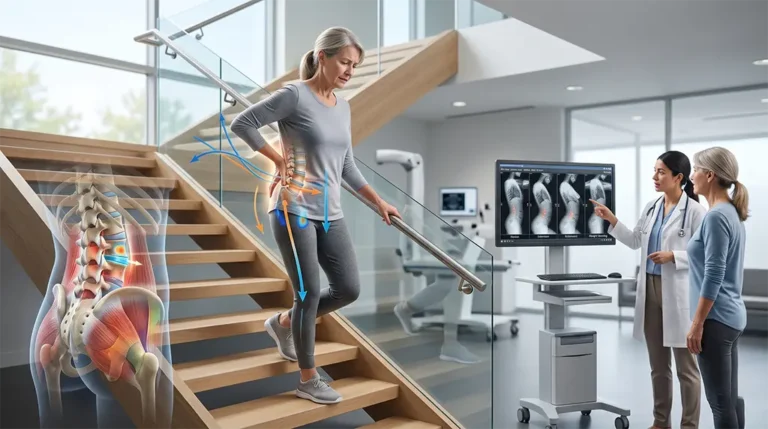
Low back pain that is worse going down stairs can reveal load-sharing and stability problems. Descending stairs creates impact, eccentric control demands, and rapid weight transfer through the hips, pelvis, and lumbar spine. Digital Motion X-Ray (DMX) evaluates lumbar motion in real time and can help identify translation, angulation, hinge segments, or instability patterns that static imaging may not show.
- Going down stairs often stresses the low back more than going up because it requires braking and control.
- Pain during descent can reflect lumbar instability, hip-pelvis compensation, or poor load sharing.
- DMX can help guide stabilization-first rehab and safer stair/lifting progressions.
Last updated: April 14, 2026
Reviewed by: DMX Miami clinical team
Many patients say they can walk on flat ground but struggle with stairs. Even more specifically, they say going down stairs is worse than going up.
They may describe:
- A sharp catch in the low back when stepping down
- Pain that increases with each step
- A feeling that the back “jars” or compresses
- Hip or buttock pain during descent
- Fear of stairs because the back feels unstable
At DMX Miami, we see this pattern in patients from Miami, Fort Lauderdale, Miami-Dade County, Broward County, and the Florida Keys, as well as visitors from the USA, Colombia, Chile, Argentina, Mexico, and the Caribbean. It is common after falls, lifting injuries, car accidents, and repeated flare cycles.
Why going down stairs is different
Going up stairs requires strength. Going down stairs requires control. The body must brake gravity with every step. That braking demand travels through the foot, knee, hip, pelvis, and lumbar spine.
If the spine shares load smoothly, stairs may feel fine. But if one lumbar segment is irritated or unstable, descending stairs can expose the problem.
The braking effect
When you step down, the body absorbs impact. Muscles work eccentrically, meaning they lengthen while controlling force. This requires excellent coordination. If the lumbar spine does not stabilize well, the body may brace, spasm, or shift load into a hinge segment.
The hinge segment problem
A hinge segment is a level that moves too much or too early compared to nearby segments. During stair descent, that hinge may experience repeated small impacts. Over a flight of stairs, the irritation builds.
Signs of a hinge pattern may include:
- Pain that worsens step by step
- Catching during descent
- Relief when holding a rail or moving slowly
- Pain with sit-to-stand or bending-returning upright
- Recurring flare after activity
Why static imaging may not explain stair pain
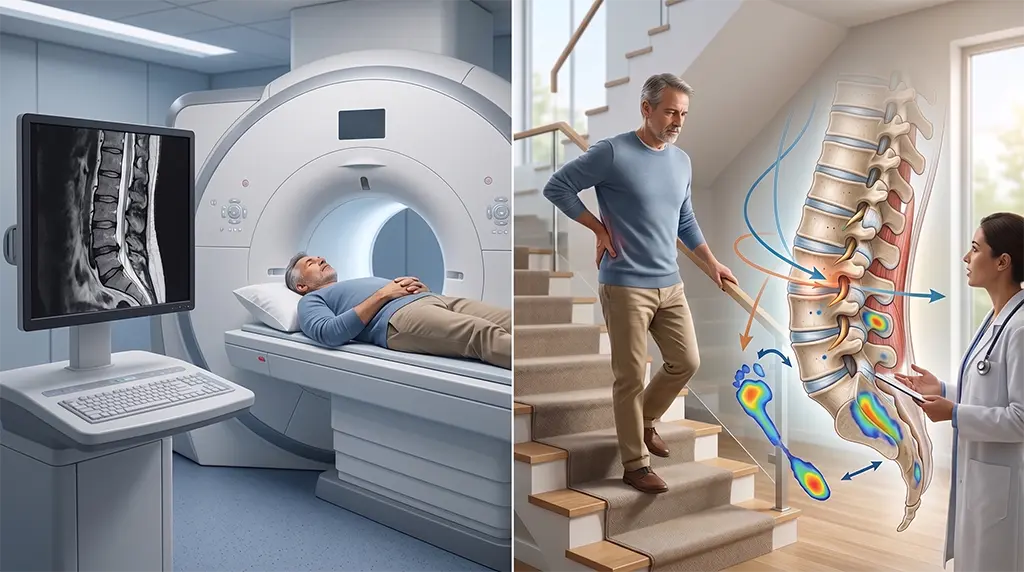
MRI is commonly performed lying down. Standard X-rays are usually still images. Stair pain is an upright, dynamic, load-transfer problem. The problem may not be obvious in neutral or supine positions.
Static imaging may not show:
- Motion-dependent translation
- Angulation during movement
- A segment that hinges under load
- Compensation between lumbar spine and pelvis
- Instability that appears only during functional arcs
How DMX evaluates lumbar motion
Digital Motion X-Ray is fluoroscopic video imaging performed during guided movement. In lumbar cases, DMX can help evaluate:
- Translation: sliding between vertebrae
- Angulation: tilting between vertebrae
- Hinge behavior: one segment moving excessively
- Sequencing: whether movement is smooth or irregular
- Asymmetry: differences between motion directions
DMX does not replace MRI, CT, or orthopedic evaluation. It complements them when the symptom is motion-triggered.
How DMX findings can change care
Stabilization-first rehab
If instability or hinge behavior is present, the first goal may be controlled stabilization, not aggressive stretching.
Stair-specific progression
Rehab can progress from flat-ground control to step-down control, eccentric hip strength, and stair tolerance.
Better hip and pelvis strategy
Sometimes the lumbar spine is overloaded because hips or pelvis are not sharing load well. Motion findings can help guide better programming.
Safer return to activity
For active patients, stair pain can be an early warning before heavier lifting, running, or sports movements flare the back.
Practical stair strategies while awaiting evaluation
- Use the handrail when symptoms are active
- Slow the descent
- Avoid carrying heavy loads down stairs during flare periods
- Step down with control rather than dropping quickly
- Track whether pain is worse descending vs ascending
- Note whether pain is one-sided or central
These details help providers match symptoms to motion patterns.
Why stair pain matters
Stairs are a functional test. If stairs are getting harder, daily independence is affected. People begin avoiding parking garages, condos, beach access stairs, and multi-level homes. In Miami Beach, Fort Lauderdale, and the Florida Keys, stairs, ramps, docks, and uneven surfaces are part of daily life.
Improving stair tolerance is not just about pain reduction. It is about restoring confidence.
Safety note
Seek medical evaluation if stair pain is associated with progressive weakness, numbness, falls, bowel/bladder symptoms, severe trauma, or inability to bear weight.
FAQs
Why does my low back hurt more going down stairs than up?
Descending requires braking and impact control, which can stress motion-sensitive lumbar segments.
Can stair pain happen with a normal MRI?
Yes. Stair pain is dynamic and load-based, while MRI is usually static and supine.
What does DMX show for lumbar instability?
DMX evaluates real-time translation, angulation, hinge behavior, and motion sequencing.
Does DMX replace physical therapy?
No. DMX can help make rehab more targeted by identifying motion patterns that need stabilization.
References
- AAOS OrthoInfo: Low back pain and mechanical loading education
- PubMed-indexed literature on lumbar instability and segmental motion biomechanics
Learn more: Treatment
Schedule your appointment today:Appointments
Call 305-275-7475 orbook your appointment online

Dr. Rodolfo Alfonso, D.C.
Dr. Mark N. Berry, D.C.
Sunset Chiropractic and Wellness
8585 Sunset Dr. STE 102
Miami, Florida 33143