
You were in a car accident. You had X-rays. Maybe you had a CT. Maybe you later had an MRI. You were told there was no fracture, major spinal-cord injury, or other obvious structural problem requiring emergency treatment.
But weeks or months later, you still have neck pain, headaches, dizziness, painful rotation, clicking or catching, shoulder-blade pain, numbness or tingling, or symptoms that worsen when you move.
So what should happen next?
The answer is not automatically: “Get another static scan.”
The better question is:
“What clinical question has not yet been answered?”
For some patients with persistent post-whiplash symptoms, that unanswered question involves function rather than anatomy alone.
Symptoms also do not always begin immediately after a crash. Learn why neck pain can appear days after a rear-end collision.
Whiplash Imaging in Miami: Local, Florida, U.S., and International Patients
DMX Miami is located in Miami and serves patients throughout South Miami, Kendall, Pinecrest, Coral Gables, Doral, Hialeah, Miami Beach, North Miami, Aventura, Miami-Dade County, Broward County, Hollywood, Miramar, Pembroke Pines, Fort Lauderdale, and the Florida Keys.
We also see patients traveling from other parts of Florida and across the United States, along with international visitors from Colombia, Chile, Argentina, Mexico, and the Caribbean who come to South Florida for motion-based cervical evaluation.
What Are CT and MRI Designed to Evaluate After Trauma?
After significant acute trauma, the first priority is identifying potentially dangerous injuries. CT provides excellent detail of bony anatomy and plays an important role in acute cervical trauma. MRI can provide additional information about the spinal cord, nerve roots, discs, many soft tissues, and certain ligament abnormalities.
These studies are extremely important when those are the clinical questions that need to be answered.
What Question Can Remain After Static Imaging?
A patient may still report:
- “My neck only hurts when I rotate.”
- “Looking up causes dizziness.”
- “My symptoms appear when I am upright and moving.”
- “My neck catches at one point in the movement.”
Now the question changes. It is no longer only “What does the anatomy look like?” It becomes:
“How does the cervical spine function under weight bearing and movement?”
For an example of this problem, read Why Does My Neck Hurt When I Turn My Head but My MRI Is Normal?.
Why Are MRI and CT Limited for That Particular Question?
Conventional MRI and CT are generally static, non-weight-bearing, performed while the patient lies down, and not recording continuous joint movement. That is appropriate for many structural questions.
But ligamentous stability is also a functional mechanical property. A ligament’s job is to control movement. Therefore, evaluating ligament function requires evaluating what happens when the joint moves.
Why Is Whiplash Particularly Relevant?
Whiplash is a dynamic injury. The injury occurs during rapid acceleration and deceleration. The cervical spine moves, ligaments are loaded, muscles react, facet joints move, and the motion segments must control the forces passing through the neck.
If the structures responsible for restraining movement are injured, the functional abnormality may become most apparent during movement. For additional background, see Whiplash Injuries and Cervical Instability.
How Do Cervical Ligaments Stabilize the Spine?
Ligaments help guide normal movement, prevent excessive translation, control angulation, restrict excessive rotation, and maintain appropriate relationships between adjacent vertebrae.
When ligamentous restraint becomes compromised, abnormal motion can occur. Possible abnormalities include:
- excessive translation
- abnormal angulation
- abnormal gapping
- asymmetrical movement
- abnormal coupled motion
- altered movement sequencing
These are functional findings.
What Does Digital Motion X-Ray Add?
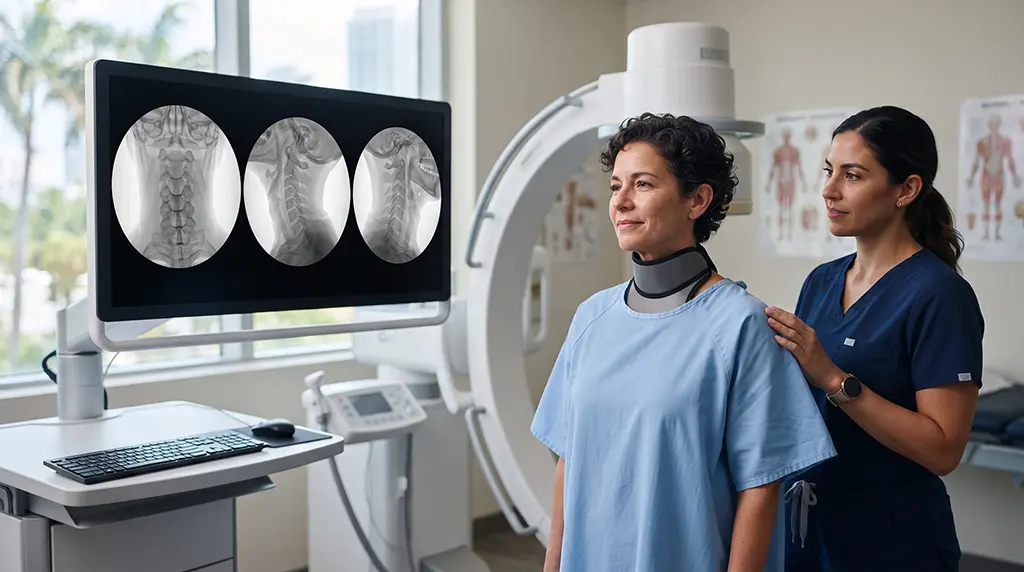
Digital Motion X-Ray evaluates the cervical spine under the conditions where it normally functions: upright + weight-bearing + moving.
The patient supports the weight of the head while performing controlled cervical movements. Fluoroscopic imaging records the vertebrae throughout the motion.
This allows evaluation of translation, angulation, intersegmental movement, asymmetry, upper-cervical motion, and movement sequencing.
Static Anatomy vs. Dynamic Function
| Imaging Study | Main Information |
|---|---|
| CT | Bone and acute traumatic anatomy |
| MRI | Spinal cord, discs, nerve roots, and many soft tissues |
| Static X-Ray | Alignment and bony relationships in a selected position |
| DMX | Functional biomechanics while upright, weight-bearing, and moving |
The studies answer different clinical questions.
Why Can Weight Bearing Change the Mechanical Question?
When you sit or stand upright, the cervical spine supports the head against gravity. That creates mechanical demand on the ligaments, muscles, discs, facet joints, and vertebral motion segments. Movement adds another challenge.
The stabilizing system must not only support the load it must control that load while the neck moves. A functional abnormality may therefore become more apparent under weight-bearing dynamic conditions than while lying still.
What Can Abnormal Motion Tell Us?
If clinically significant excessive translation, angulation, or another abnormal movement pattern is documented after trauma, it can provide objective biomechanical information regarding motion-segment function.
Because ligaments are responsible for limiting excessive movement, abnormal intersegmental motion becomes relevant when evaluating suspected ligamentous instability. The finding becomes most meaningful when it correlates with the mechanism of injury, onset of symptoms, physical examination, neurological findings, previous imaging, and functional complaints.
What About Persistent Headaches After a Collision?
Headache can have several causes after trauma. But when headaches are associated with neck pain and repeatedly aggravated by turning, driving, looking down, looking up, or prolonged posture, the cervical spine may be part of the clinical picture.
Read more about persistent headaches after a car accident and cervical ligament instability.
Patients with dizziness, brain fog, or concussion-like symptoms can also review Post-Concussion Symptoms With Neck Pain.
Who May Benefit From Further Dynamic Evaluation?
- persistent symptoms after whiplash
- pain that appears with specific movements
- dizziness associated with head movement
- tingling that changes with neck position
- painful catching
- symptoms despite reassuring static imaging
- rehabilitation that has stalled
- suspected cervical instability
For a broader explanation of movement-triggered symptoms, read Why Do My Neck Symptoms Happen Only When I Move?.
Still Searching for an Explanation After Your Accident?
If your previous imaging evaluated structure but your symptoms remain strongly associated with movement, evaluating the cervical spine under upright, weight-bearing motion may provide another important part of the clinical picture.
Contact DMX Miami to discuss your previous imaging and symptoms, or call 305-275-7474. Patients traveling from outside South Florida are encouraged to bring prior MRI, CT, X-ray reports, and relevant medical records.
Frequently Asked Questions
Why can symptoms remain after a normal CT?
CT is excellent for many bony injuries, but persistent symptoms may involve muscles, discs, nerves, ligaments, joints, or abnormal biomechanics.
Why can symptoms remain after MRI?
MRI provides valuable structural information but is generally static and non-weight-bearing. A movement-dependent functional problem may require a different type of evaluation.
Why is motion important for ligament assessment?
The mechanical job of a ligament is to control movement. Its functional integrity is assessed by determining whether the joint remains appropriately controlled during motion.
What makes DMX different?
DMX evaluates the cervical spine upright, weight-bearing, and moving rather than only in a static position.
Can whiplash affect ligament stability?
Yes. Acceleration-deceleration trauma can stress cervical ligaments, and impaired ligamentous restraint can alter vertebral motion.
When should DMX be considered?
When symptoms are persistent and reproducibly related to cervical movement and functional motion assessment may affect clinical management.
References
- American College of Radiology / RadiologyInfo – Suspected Spine Trauma
- Wang et al. – The Quantitative Measurements of the Intervertebral Angulation and Translation During Cervical Flexion and Extension
- Published whiplash, cervical biomechanics, and videofluoroscopy literature
DMX Miami serves patients in Miami, Fort Lauderdale, Miami-Dade, Broward, the Florida Keys, Florida, the USA, and visitors fromColombia, Chile, Argentina, Mexico, and the Caribbean.
Learn more: Treatment
Schedule your appointment today:Appointments
Call 305-275-7475 orbook your appointment online

Dr. Rodolfo Alfonso, D.C.
Dr. Mark N. Berry, D.C.
Sunset Chiropractic and Wellness
8585 Sunset Dr. STE 102
Miami, Florida 33143