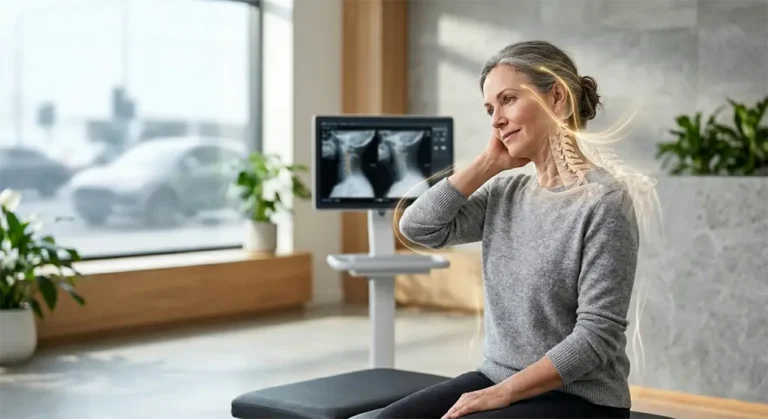
If headaches began after a collision and flare with head turning, looking up/down, driving, or screen time, the driver may be motion-dependent cervical mechanics even if MRI is “normal.” Digital Motion X-Ray (DMX) is motion-based fluoroscopic video imaging that evaluates real-time cervical segment behavior (translation and angulation) during the arcs that trigger symptoms.
- Post-collision headaches often track with motion, posture load, and neck fatigue not just “stress.”
- MRI/CT show structure; DMX helps evaluate function in motion (translation/angulation, asymmetry, hinge segments).
- Motion findings can guide stabilization-first rehab, safer manual technique selection, and clearer documentation.
Last updated: April 14, 2026
Reviewed by: DMX Miami clinical team
Headaches after a car accident are common yet also commonly misunderstood. Many people are told they have “tension headaches,” “migraines,” or that it will “just take time.” Others get an MRI that reads as mild or normal and are left wondering why they still feel pressure behind the eyes, base-of-skull pain, or headaches that ramp up through the day.
At DMX Miami, we see post-collision headache patterns in patients from Miami, Fort Lauderdale, Miami-Dade County, Broward County, and the Florida Keys, as well as visitors traveling through Florida from the USA and from Colombia, Chile, Argentina, Mexico, and the Caribbean. A recurring theme: the headache is not random. It is often tied to motion triggers driving, checking blind spots, looking down at a phone, or looking up at traffic lights.
Why headaches after a crash can be “neck-driven”

The head and neck function as one mechanical unit. When the cervical spine is injured (even subtly), the nervous system often compensates by increasing muscle guarding to stabilize the head. That guarding can create sustained tension in the suboccipitals, upper trapezius, scalenes, and deep neck stabilizers. Over time, that tension can produce a headache pattern that:
- starts at the base of the skull.
- travels to the temples or behind the eyes.
- worsens with posture load or head motion.
- improves temporarily with rest, manual work, or “cracking,” then returns.
Whiplash is not just a muscle injury
In a collision, rapid acceleration-deceleration can strain ligaments that control joint motion. Ligaments don’t “fire” like muscles they guide and limit motion. If ligament control is compromised, segments may move abnormally during certain arcs. The body often responds by tightening muscles to protect the area. That protective strategy can be useful short-term, but it can drive persistent headache patterns when it becomes chronic.
Why your MRI can be normal and your headaches still severe
MRI is excellent for discs, spinal cord, nerve roots, and many structural conditions. But most MRIs are taken in a neutral, static position (often lying down). If your headache is triggered by motion turning, extension, flexion, or combined movements the driver may be functional and dynamic. Static imaging might not capture:
- abnormal translation (sliding) during motion.
- abnormal angulation (tilting) during motion.
- asymmetry between left and right arcs.
- a hinge segment that “dumps” motion while other segments remain stiff.
In other words: a static picture can look reassuring while your real-life trigger remains.
What DMX evaluates for post-collision headaches
Digital Motion X-Ray (DMX) is fluoroscopic video imaging performed with controlled, guided motion. In cervical cases, DMX can help evaluate:
- Translation: how much one vertebra shifts relative to another during movement.
- Angulation: how much one vertebra tilts relative to another during movement.
- Symmetry: left vs right motion behavior.
- Sequencing: whether a segment hinges early or excessively in the arc.
- Global behavior: how the cervical spine shares motion under guidance.
DMX is not a replacement for MRI or CT. It is used when the clinical question is: what happens during the movement arc that reliably provokes symptoms?
Common headache triggers that suggest a motion-dependent pattern
Consider a motion-based evaluation when headaches:
- flare when looking down at a phone or laptop (sustained flexion).
- flare when looking up (extension).
- flare during driving (posture load + rotation).
- worsen through the day with neck fatigue (“heavy head”).
- improve briefly with manual therapy but return quickly.
- show a consistent left vs right difference (turning one way is worse).
How DMX findings can change treatment decisions
A common frustration is “I tried everything.” But many plans fail because they treat symptoms instead of mechanics. When motion behavior is clarified, care can become more targeted:
1) Stabilization-first rehab
If motion patterns suggest instability or hinge behavior, the first goal is often controlled stabilization and motor control—not aggressive stretching into end ranges.
2) Safer manual technique selection
Some patients feel better after adjustments, then flare worse. That doesn’t mean adjustments are universally harmful; it may mean technique choice and level selection need to match the stability profile.
3) Better exercise programming
Many headaches flare from the wrong “neck exercises” (too much extension too soon, heavy bracing, aggressive stretching). Motion data can guide what to avoid temporarily and what to emphasize.
4) Clearer communication and documentation
Objective motion findings can improve communication among providers and help align care around triggers and measurable goals.
What patients can do while waiting for imaging (general guidance)
- Keep a trigger log: time, arc (turning left/right, looking up/down), headache score (1–10).
- Reduce repeated end-range “testing.”
- Use posture breaks: 2–3 minutes of movement every 45–90 minutes.
- Focus on consistent sleep; poor sleep increases pain sensitivity.
Safety note: when headaches require urgent evaluation
Seek urgent medical care for sudden “worst headache of life,” new weakness, facial droop, speech changes, fainting, chest pain, or severe neurological changes.
FAQs
Can a car accident cause headaches even if my MRI is normal?
Yes. If the driver is motion-dependent mechanics or ligament-related instability, static imaging may not capture the functional trigger.
What does DMX show that a regular X-ray doesn’t?
DMX shows continuous motion behavior through movement arcs, including translation/angulation patterns and asymmetry.
Does DMX replace MRI?
No. DMX complements MRI/CT/X-ray when motion and stability are the key questions.
How do I know if my headache is “neck-driven”?
Clues include motion triggers, posture-load triggers, neck fatigue, and consistent reproduction with specific arcs.
References:
- Cleveland Clinic: Cervicogenic headache and neck-related headache education.
- PubMed-indexed literature on whiplash-associated disorders, cervical ligament injury, and cervicogenic headache mechanisms.
Learn more: Treatment
Schedule your appointment today:Appointments
Call 305-275-7475 orbook your appointment online

Dr. Rodolfo Alfonso, D.C.
Dr. Mark N. Berry, D.C.
Sunset Chiropractic and Wellness
8585 Sunset Dr. STE 102
Miami, Florida 33143