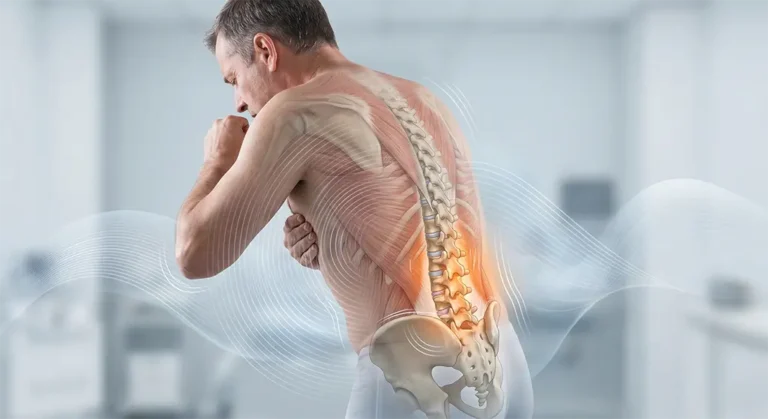
If coughing or sneezing spikes back pain, it can reflect a load-sensitive mechanical pattern where pressure and reflex bracing stress a vulnerable spinal segment. DMX evaluates real-time motion behavior (translation and angulation) during guided arcs to help identify hinge segments or instability patterns especially when symptoms are movement‑triggered and static imaging doesn’t match function.
- Cough/sneeze pain is often a pressure + reflex bracing trigger, not “random.”
- Static MRI/X‑ray shows structure at rest; DMX helps evaluate motion behavior through arcs.
- Motion findings can guide stabilization-first rehab, safer lifting/hinge strategy, and clearer activity rules.
Last updated: April 14, 2026
Reviewed by: DMX Miami clinical team
Introduction
Back pain that spikes when you cough or sneeze is one of the most alarming sensations people experience. Many patients describe it as a lightning bolt that forces them to freeze. In South Florida Miami, Fort Lauderdale, Miami‑Dade County, Broward County, and the Florida Keys this is a common complaint after lifting injuries, falls, or recurring flare cycles. We also see visitors from the USA, Colombia, Chile, Argentina, Mexico, and the Caribbean who notice that long travel days and long sitting increase baseline sensitivity, making cough/sneeze spikes more likely.
This blog is educational. If you have severe pain with fever, progressive weakness, bowel/bladder changes, or other red flags, seek medical evaluation promptly.
Why coughing and sneezing can trigger back pain
A cough or sneeze does two things at once: it spikes internal pressure and triggers a reflex brace. Even if you are not lifting, your trunk muscles contract powerfully and quickly. If a spinal segment is mechanically vulnerable, that split-second load transfer can provoke a sharp spike or “catch.”
Pressure-triggered pain vs motion-triggered pain
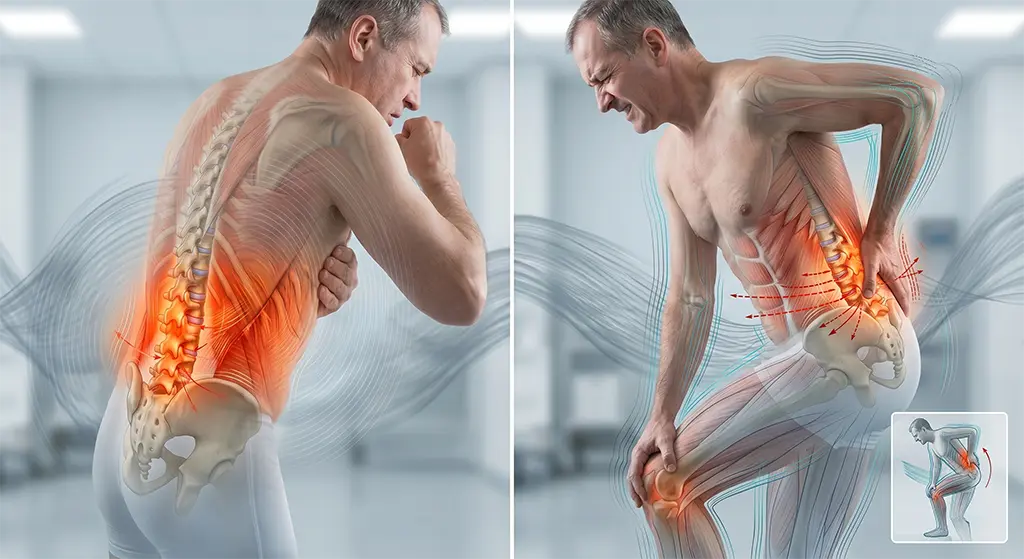
Cough/sneeze pain is often called “pressure pain,” but it is frequently mechanical because the brace event forces segments to share stiffness and motion instantly. If one segment hinges (moves too much or too early), it can take the brunt of the load. That can produce a sharp, repeatable spike even when you feel okay between episodes.
Why MRI can look mild while cough/sneeze pain is severe
MRI is usually performed lying down in neutral. That reduces load and does not recreate a rapid brace event. Many motion problems are not about one structure looking “bad,” but about how segments behave under movement and load:
- Does one level translate (slide) excessively during an arc?
- Does one level angulate (tilt) irregularly, creating a hinge?
- Is motion shared smoothly, or does it dump into one segment?
These are functional questions. Static imaging may be essential, but it may not fully answer them.
What DMX evaluates in the lumbar spine
Digital Motion X‑Ray (DMX) is fluoroscopic video imaging performed with guided motion. In lumbar cases, providers may assess:
- Translation: sliding between vertebrae during motion
- Angulation: tilting between vertebrae during motion
- Symmetry: left vs right behavior
- Sequencing: whether a hinge segment dominates early in the arc
DMX does not replace MRI/CT/X‑ray. It complements them when the clinical question is motion and stability.
How DMX can change treatment decisions
DMX is most valuable when it changes the plan. Depending on findings, providers may:
- Prioritize stabilization and motor control before aggressive stretching.
- Modify hinge training (how you bend, lift, and stand) so movement doesn’t keep feeding the hinge segment.
- Adjust exercises that repeatedly provoke spikes by reducing end‑range loading and improving controlled stiffness.
- Provide clearer activity rules: avoiding combined rotation + extension early, breaking up sitting, and using hip-dominant strategies.
- Set milestones: fewer brace‑spikes, easier sit-to-stand, improved first steps, improved tolerance to daily life.
Practical steps while awaiting evaluation (general guidance)
- When you feel a cough/sneeze coming, brace gently and keep posture tall rather than slumped.
- Avoid twisting during the event; face forward so the brace is symmetrical.
- Break up long sitting: stand and walk 2–3 minutes every 45–90 minutes.
- Track the pattern: does it happen more after sitting, after driving, or after bending?
Safety note
Seek urgent care for progressive weakness, severe numbness, bowel/bladder changes, fever, or unexplained weight loss. Motion imaging is not a substitute for urgent medical evaluation.
FAQs
Why does coughing or sneezing hurt my back?
It creates a rapid pressure spike and reflex brace that can stress a vulnerable segment, especially if hinge/instability behavior is present.
Can this happen with a normal MRI?
Yes. MRI is static; cough/sneeze spikes can be driven by motion behavior not reproduced in neutral positioning.
What does DMX add?
Real-time translation/angulation, asymmetry, and hinge patterns through guided movement arcs.
Does DMX replace MRI?
No. It complements MRI/CT/X‑ray when motion and stability are the key questions.
References
- AAOS OrthoInfo: Low back pain education and mechanical triggers.
- PubMed-indexed literature on lumbar instability/segmental motion and dynamic imaging concepts.
Learn more: Treatment
Schedule your appointment today:Appointments
Call 305-275-7475 orbook your appointment online

Dr. Rodolfo Alfonso, D.C.
Dr. Mark N. Berry, D.C.
Sunset Chiropractic and Wellness
8585 Sunset Dr. STE 102
Miami, Florida 33143