
Persistent shoulder pain especially after a fall, collision, or repetitive overhead work sometimes remains “stuck” because cervical mechanics are contributing. If shoulder symptoms worsen with he ad position, posture load, or rotation, the neck may be a driver rather than the shoulder alone. DMX evaluates cervical motion in real time (translation and angulation) to help identify instability or hinge patterns that can influence scapular control, nerve irritation, and shoulder symptom persistence.
- Shoulder blade and shoulder pain can be referred or maintained by cervical mechanics, especially after whiplash.
- Static imaging may not capture motion-dependent instability or asymmetry in the cervical spine.
- DMX findings can guide stabilization-first rehab, safer overhead progression, and clearer differentiation between shoulder-only and neck-influenced pain.
Last updated: April 14, 2026
Reviewed by: DMX Miami clinical team
In Miami, Fort Lauderdale, Miami-Dade, Broward, and the Florida Keys, we see many active people with shoulder pain that keeps returning especially when driving, working at a laptop, or training overhead. We also see visitors from the USA, Colombia, Chile, Argentina, Mexico, and the Caribbean. A common clue: turning the head or changing posture changes the shoulder symptoms.
Why the neck can keep the shoulder “stuck”
The shoulder is controlled by a chain: cervical spine and nerve input, scapular mechanics, the shoulder joint, and thoracic posture. If cervical mechanics are irritated or unstable, the body may guard, altering scapular rhythm and increasing shoulder load.
Pattern clue: head position changes shoulder symptoms
More likely when symptoms worsen with looking down, driving, rotation left vs right differences, overhead activity triggers neck fatigue first, or tingling/heaviness accompanies the pain.
Why static imaging can miss the driver
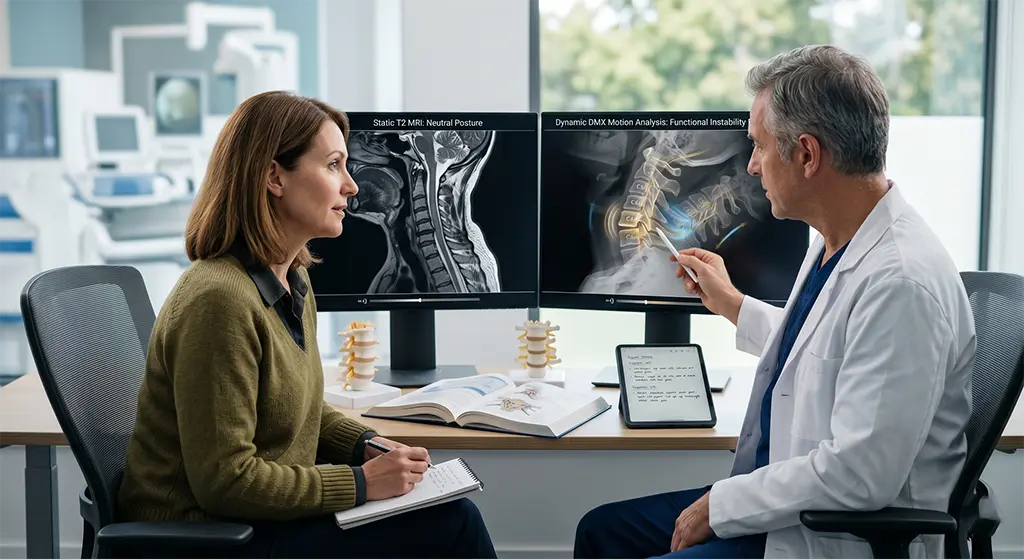
Many cases are motion dependent: the driver is asymmetry, rotation/extension triggers, or a hinge segment. Static studies may not capture translation/angulation behavior that appears during movement arcs.
What DMX evaluates
DMX evaluates translation, angulation, symmetry, and hinge behavior during guided cervical motion.
How DMX findings can change the plan
- Stabilization-first programming when hinge/instability is present
- Safer overhead progression (limit provocative arcs temporarily)
- Better differentiation of whether the shoulder or neck is primary
FAQs
Can the neck cause shoulder pain?
Yes, in some cases through referral patterns and altered scapular control from guarding.
What does DMX add?
Real-time cervical motion behavior (translation/angulation) and asymmetry through guided arcs.
Does DMX replace shoulder MRI?
No DMX complements evaluation when symptoms suggest cervical contribution.
References
- Cleveland Clinic: Shoulder pain and neck pain education resources.
- PubMed-indexed literature on cervicogenic referral and whiplash-associated disorders
Learn more: Treatment
Schedule your appointment today:Appointments
Call 305-275-7475 orbook your appointment online

Dr. Rodolfo Alfonso, D.C.
Dr. Mark N. Berry, D.C.
Sunset Chiropractic and Wellness
8585 Sunset Dr. STE 102
Miami, Florida 33143