
Why Sports Concussions Are More Than Just a Brain Injury
Athletes in Miami, Florida, and across Central and South America including Colombia, Argentina, Chile, and Mexico are familiar with the risks of concussions. Football, soccer, rugby, wrestling, and even cycling frequently cause head trauma. While most people associate concussions with brain injury, many athletes also develop chronic neck pain, dizziness, and instability after these incidents.
The overlooked factor? Cervical ligament damage. When the head is jolted during impact, it’s not just the brain that suffers the neck ligaments are stretched or torn, creating ligament laxity that destabilizes the spine.
The Role of Ligaments in Head and Neck Stability
Ligaments in the cervical spine keep the vertebrae aligned and protect nerves, arteries, and the spinal cord. During sports trauma:
- Ligaments may stretch or tear, allowing excessive vertebral movement.
- Instability develops, irritating nerves and blood vessels.
- Athletes experience headaches, dizziness, or “brain fog”, often mistaken as purely neurological.
- Muscles overcompensate, leading to stiffness and chronic pain.
This hidden ligament damage can worsen concussion symptoms and prolong recovery.
Why Standard Imaging Fails to Detect the Problem
Most athletes undergo MRIs or CT scans after a concussion. While excellent at identifying bleeding or fractures, these tests are static images. They cannot show how vertebrae move during head motion.
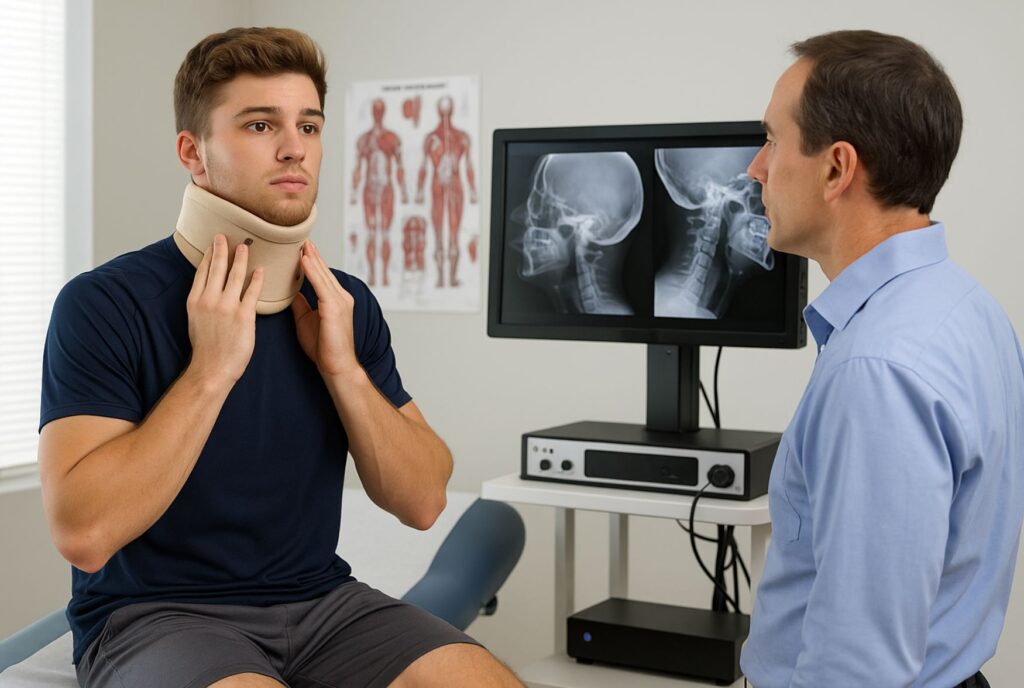
Ligament laxity is a motion-based problem, only visible when the cervical spine bends, twists, or extends. This is why so many athletes are told their scans look “normal” even when symptoms persist.
How Digital Motion X-Ray Provides Answers
Digital Motion X-Ray (DMX) is the breakthrough imaging test that reveals hidden ligament laxity after sports concussions. By capturing real-time X-ray video at 30 frames per second, DMX allows physicians to watch how the cervical spine behaves during controlled movements.
DMX shows:
- Abnormal vertebral gapping or sliding during head motion
- Evidence of ligament laxity responsible for instability
- The correlation between symptoms and movement patterns
- Objective proof that validates the athlete’s ongoing complaints
This technology is especially valuable for athletes seeking to explain why concussion symptoms never fully resolved.
Symptoms That Suggest Ligament Laxity After Concussion
If you are an athlete experiencing these symptoms after a concussion or head injury, cervical ligament instability may be the missing link:
- Persistent headaches or migraines
- Dizziness or vertigo when moving the head
- Difficulty focusing or brain fog
- Chronic neck stiffness or pain
- Tingling, numbness, or weakness in the arms
- Fatigue or imbalance during training
These symptoms may not be from the brain alone they may be signs of unresolved neck ligament damage.
Why Miami Is the Destination for DMX in Athletes
Our Miami clinic is one of the few centers offering DMX for athletes with sports concussions. Patients come from Florida, across the U.S., and internationally from Colombia, Argentina, Mexico, Chile, and beyond because:
- DMX is not widely available in their home countries.
- We provide bilingual care in English and Spanish, ensuring comfort and understanding.
- Miami is a major hub for both athletics and advanced medical diagnostics.
This makes our clinic the destination for athletes who need definitive answers.
Benefits of Accurate DMX Diagnosis
When DMX identifies ligament laxity, athletes finally understand why their symptoms persist. With this knowledge, they can pursue:
- Regenerative medicine therapies to repair ligaments
- Targeted rehabilitation to restore stability and mobility
- Safer return-to-play decisions, preventing further injury
- Customized treatment plans built around objective imaging evidence
This empowers athletes to recover more fully and protect their long-term health.
Taking the Next Step Toward Recovery
If you’ve experienced a concussion or sports-related head trauma and still struggle with symptoms, don’t settle for incomplete answers. The problem may be ligament instability that only Digital Motion X-Ray in Miami can reveal.
Learn more: Treatment
Schedule your appointment today: Appointments
Don’t let hidden ligament damage hold you back from recovery and performance.
Call 305-275-7475 or book your appointment online

Dr. Rodolfo Alfonso, D.C.
Dr. Mark N. Berry, D.C.
Sunset Chiropractic and Wellness
8585 Sunset Dr. STE 102
Miami, Florida 33143
305-275-7475