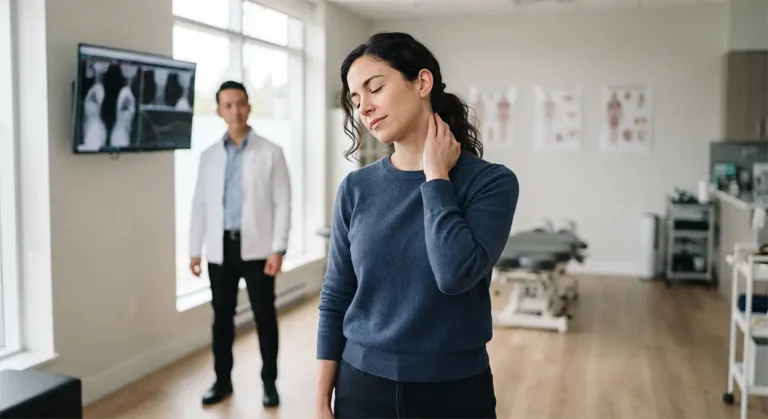
Neck clicking is often harmless when it occurs without symptoms. But clicking, clunking, or popping that is paired with dizziness, headaches, pain, visual strain, or instability sensations may suggest motion sensitivity or abnormal cervical mechanics. Digital Motion X-Ray (DMX) evaluates cervical motion in real time and can help identify translation, angulation, asymmetry, or hinge patterns that static imaging may not show.
- Neck noise alone is not always concerning, but noise plus symptoms matters.
- Dizziness with clicking may reflect cervical motion sensitivity or proprioceptive irritation.
- DMX can help evaluate real-time cervical motion when symptoms are reproducible.
Last updated: April 14, 2026
Reviewed by: DMX Miami clinical team
Many people have neck cracking or clicking. In many cases, it is not serious. But when clicking is paired with symptoms, the meaning changes.
Patients may say:
- “My neck clicks and then I feel dizzy.”
- “I hear a clunk when I turn.”
- “The pop comes with a headache.”
- “My neck feels unstable.”
- “The noise is new after my accident.”
- “It clicks more when I’m tired.”
At DMX Miami, we see this in patients from Miami, Fort Lauderdale, Miami-Dade County, Broward County, and the Florida Keys, as well as visitors from the USA, Colombia, Chile, Argentina, Mexico, and the Caribbean. Many have a history of whiplash, falls, sports impacts, or chronic neck instability symptoms.
When neck clicking is probably less concerning
Neck clicking without pain, dizziness, neurological symptoms, or functional limitation is often benign. Joints can make noise because of gas release, tendon movement, or normal joint mechanics.
But symptoms change the conversation.
Why noise plus symptoms matters
If clicking is associated with dizziness, pain, headache, or visual strain, it may indicate that the noise is part of an abnormal movement pattern.
The concern is not the sound itself. The concern is what happens with the sound.
Does the click happen at the same point in motion?
If the click occurs repeatedly at the same angle or direction, that may suggest a segment is moving differently at that point.
Does dizziness follow the click?
Dizziness after neck motion may involve cervical proprioception, vestibular factors, or other systems. If it is consistently linked to neck movement, cervical mechanics should be considered.
Is the clicking new after trauma?
New clicking after whiplash or a fall is more clinically meaningful than lifelong painless cracking.
Cervical proprioception and dizziness
The neck contains sensors that help the brain understand head position. If cervical motion is irregular or guarded, the brain may receive conflicting input. In some patients, this can contribute to dizziness, fogginess, or visual discomfort.
This does not mean the neck is always the only cause of dizziness. But it may be an important contributor.
Why static imaging may not show clicking patterns
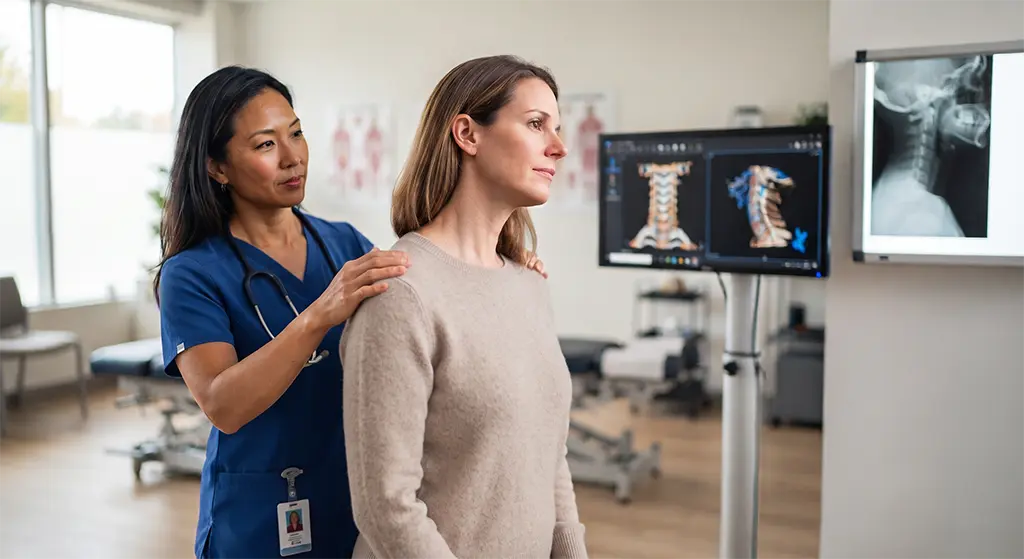
MRI and standard X-rays are static. They do not show the exact moment a click occurs during motion.
Static imaging may not capture:
- translation during rotation
- abnormal angulation
- a hinge segment
- left-right asymmetry
- irregular motion sequencing
- instability that appears only during movement
How DMX evaluates cervical clicking with symptoms
Digital Motion X-Ray records cervical motion using fluoroscopic video imaging. Providers can evaluate how the cervical vertebrae move through guided arcs.
DMX may help identify:
- Translation: sliding between vertebrae
- Angulation: tilting between vertebrae
- Asymmetry: left vs right differences
- Hinge behavior: one segment moving too much
- Motion sequencing: irregular movement timing
DMX does not replace vestibular, neurological, or vascular evaluation. It complements care when symptoms are motion-triggered.
How DMX findings can change care
Avoid chasing the sound
The goal is not to “remove the click.” The goal is to understand whether the click is associated with abnormal motion and symptoms.
Stabilization-focused rehab
If abnormal motion is present, rehab may focus on controlled motion, deep neck stabilizer endurance, and proprioceptive retraining.
Safer manual therapy
Patients who repeatedly crack their neck for relief may be feeding an unstable pattern. DMX findings can help guide safer care choices.
Trigger-specific guidance
If clicking and dizziness occur with rotation, the plan may temporarily reduce end-range rotation while stability improves.
Practical steps while awaiting evaluation
- Do not repeatedly force the click
- Track which direction produces it
- Note whether dizziness follows immediately or later
- Track headaches, visual strain, or arm symptoms
- Avoid aggressive self-manipulation
- Use posture breaks during screen work and driving
Safety note
Seek urgent medical evaluation for sudden severe dizziness, fainting, neurological changes, severe headache, vision loss, chest pain, or new weakness.
FAQs
Is neck clicking dangerous?
Often no, if painless and not associated with symptoms. Clicking with dizziness, pain, or neurological symptoms should be evaluated.
Can neck clicking cause dizziness?
The clicking itself may not cause dizziness, but abnormal cervical motion associated with the click may contribute in some cases.
What does DMX show?
DMX evaluates real-time translation, angulation, asymmetry, hinge behavior, and motion sequencing.
Does DMX replace vestibular testing?
No. DMX complements evaluation when cervical motion appears linked to dizziness.
References
- Cleveland Clinic: Neck pain and dizziness education
- PubMed-indexed literature on cervicogenic dizziness and cervical proprioception
Learn more: Treatment
Schedule your appointment today:Appointments
Call 305-275-7475 orbook your appointment online

Dr. Rodolfo Alfonso, D.C.
Dr. Mark N. Berry, D.C.
Sunset Chiropractic and Wellness
8585 Sunset Dr. STE 102
Miami, Florida 33143