
Neck pain, headaches, arm tingling, or pressure that spikes during coughing or sneezing can be a clue that the cervical spine is sensitive to sudden pressure and reflex bracing. A cough or sneeze rapidly loads the spine, neck muscles, and stabilizing ligaments. Digital Motion X-Ray (DMX) evaluates cervical motion in real time and can help identify abnormal translation, angulation, hinge patterns, or instability that static imaging may not show.
- Coughing and sneezing create sudden pressure and reflex bracing through the neck and spine.
- Pain that spikes with coughing/sneezing may be motion- or stability-related.
- DMX can help evaluate cervical translation, angulation, asymmetry, and hinge behavior during guided motion.
Last updated: April 14, 2026
Reviewed by: DMX Miami clinical team
Most people do not think about the neck when they cough or sneeze. But patients with cervical injury, whiplash, or instability patterns often notice that a simple sneeze can create a sharp spike.
Patients may say:
- “When I sneeze, my neck feels like it shocks.”
- “Coughing triggers a base-of-skull headache.”
- “My arm tingles after I sneeze.”
- “I brace because I know it will hurt.”
- “My MRI doesn’t explain why coughing hurts so much.”
At DMX Miami, we see this in patients from Miami, Fort Lauderdale, Miami-Dade County, Broward County, and the Florida Keys, and also in visitors from the USA, Colombia, Chile, Argentina, Mexico, and the Caribbean. Many have a history of rear-end collisions, falls, sports injuries, or chronic neck pain that worsens with sudden movement.
This blog is educational. Severe headache, neurological symptoms, fever, severe trauma, or rapidly worsening symptoms require medical evaluation.
Why coughing and sneezing affect the neck
A cough or sneeze is a whole-body event. It creates a sudden increase in pressure and a rapid reflex contraction through the trunk, shoulders, and neck.
The neck may be stressed by:
- sudden bracing
- rapid head movement
- pressure changes
- muscle contraction
- ligament loading
- spinal stiffness before and after the event
If cervical tissues are irritated, that sudden event can trigger pain.
Why this symptom matters
A cough/sneeze spike is important because it is repeatable and mechanical. It is not vague. It happens during a predictable event. That makes it a useful clinical clue.
The question becomes: why does sudden pressure or bracing reproduce symptoms?
Possible contributors include:
- irritated cervical joints
- disc or nerve sensitivity
- ligament strain
- abnormal motion control
- cervical instability
- muscle guarding from injury
- upper cervical sensitivity
The “brace and spike” pattern
Many patients learn to brace before coughing or sneezing because they expect pain. This creates a cycle:
- The patient anticipates pain
- Neck and shoulder muscles tighten
- The cough/sneeze occurs
- A sudden pressure spike loads the area
- Pain, headache, or tingling follows
- Guarding increases afterward
If this happens repeatedly, the nervous system may become more protective and symptoms can spread into daily movements.
Why static imaging may not explain cough/sneeze pain
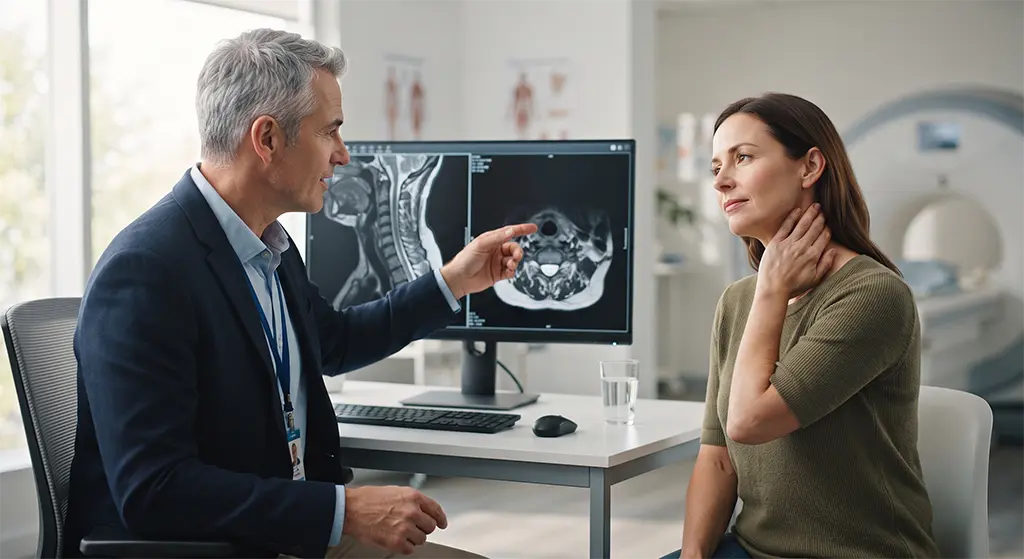
MRI and CT are valuable, especially when neurological symptoms are present. But coughing and sneezing involve dynamic pressure and bracing, not still posture.
Static imaging may not show:
- abnormal translation during motion
- abnormal angulation during flexion/extension
- hinge behavior
- instability that appears only during movement
- asymmetry with rotation
- motion sensitivity that matches symptoms
A patient may look “mild” on static imaging yet have severe spikes during sudden pressure events.
How Digital Motion X-Ray helps
Digital Motion X-Ray uses fluoroscopic video imaging to evaluate the cervical spine during guided motion. It helps answer a motion question: how do the vertebrae behave when the neck moves?
DMX may identify:
- Translation: sliding between vertebrae
- Angulation: tilting between vertebrae
- Asymmetry: left/right motion differences
- Hinge patterns: one segment taking too much motion
- Sequencing: irregular movement through the arc
DMX does not reproduce a sneeze. Instead, it evaluates whether the spine has abnormal motion patterns that may explain why sudden pressure events trigger symptoms.
When DMX may be helpful
Consider DMX when cough/sneeze symptoms occur with:
- neck pain after whiplash
- headaches at the base of the skull
- dizziness with neck motion
- arm tingling or shoulder-blade burning
- pain that changes with looking up/down
- symptoms that worsen after driving or screen time
- normal or mild static imaging but ongoing functional limitation
How DMX findings can change care
Stabilization-first rehab
If instability patterns are found, care may prioritize controlled stabilization and endurance instead of aggressive stretching.
Bracing strategy
Patients may learn safer ways to brace during coughing/sneezing without over-tightening the neck.
Manual care modification
Providers may avoid forceful techniques into unstable segments and focus on safer motion control.
Activity rules
If extension, rotation, or flexion patterns match symptoms, daily activity can be modified while stability improves.
Practical steps while awaiting evaluation
- Keep the neck neutral when a sneeze is coming
- Avoid twisting while coughing/sneezing
- Gently brace the trunk rather than shrugging the shoulders
- Track whether pain goes into the head, shoulder blade, or arm
- Note whether symptoms linger or fade quickly
- Seek evaluation if symptoms are worsening
Safety note
Seek urgent medical evaluation if coughing/sneezing triggers severe sudden headache, neurological symptoms, fainting, weakness, vision changes, fever, or severe neck stiffness.
FAQs
Why does my neck hurt when I cough or sneeze?
Coughing and sneezing create sudden pressure and reflex bracing that can stress irritated or unstable cervical segments.
Can this happen after whiplash?
Yes. Whiplash can increase motion sensitivity and guarding, making sudden pressure events more painful.
What does DMX add?
DMX evaluates real-time cervical motion, including translation, angulation, asymmetry, and hinge behavior.
Does DMX replace MRI?
No. DMX complements MRI/CT/X-ray when symptoms are motion- or pressure-triggered.
References
- Cleveland Clinic: Neck pain and whiplash education
- PubMed-indexed literature on cervical instability and whiplash-associated disorders
Learn more: Treatment
Schedule your appointment today:Appointments
Call 305-275-7475 orbook your appointment online

Dr. Rodolfo Alfonso, D.C.
Dr. Mark N. Berry, D.C.
Sunset Chiropractic and Wellness
8585 Sunset Dr. STE 102
Miami, Florida 33143