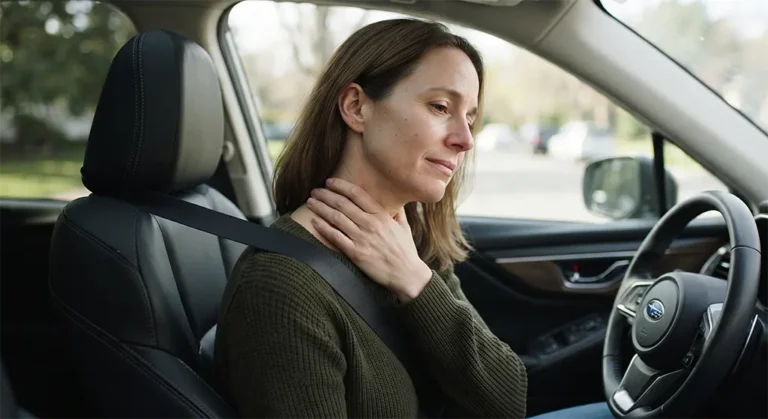
Seatbelt pain after a car accident is often dismissed as simple bruising, but persistent pain near the collarbone, lower neck, shoulder blade, or upper back can reflect deeper motion sensitivity. The seatbelt restrains the torso while the head and neck continue moving, which can stress the cervical spine, cervicothoracic junction, ribs, and shoulder girdle. Digital Motion X-Ray (DMX) evaluates cervical motion in real time and can help identify abnormal translation, angulation, asymmetry, or hinge patterns when symptoms persist after static imaging looks mild.
- Seatbelt injuries can create more than surface bruising; they can reveal cervical and upper-back motion problems.
- Pain that persists with turning, looking down, carrying bags, or driving may be motion-dependent.
- DMX helps evaluate real-time cervical motion, including translation, angulation, asymmetry, and instability patterns.
Last updated: April 14, 2026
Reviewed by: DMX Miami clinical team
After a car accident, many patients notice soreness across the chest, collarbone, shoulder, lower neck, or upper back where the seatbelt restrained them. Some soreness is expected. But when symptoms continue for weeks or months, or when pain becomes clearly tied to motion, the situation deserves a closer look.
At DMX Miami, we see patients from Miami, Fort Lauderdale, Miami-Dade County, Broward County, and the Florida Keys, as well as visitors from the USA, Colombia, Chile, Argentina, Mexico, and the Caribbean, who describe the same pattern:
- “My collarbone area still hurts after the crash.”
- “The pain goes from my lower neck into my shoulder blade.”
- “My seatbelt area is sore, but my neck also clicks now.”
- “Driving makes the same area flare.”
- “My X-rays were negative, but I still feel unstable.”
The key is not only where the seatbelt contacted the body. The key is how the body moved around the restraint during the crash.
Why seatbelt injuries can involve the neck
A seatbelt restrains the torso. That is its job. But during a collision, the head and neck may still move rapidly while the chest is held back. This can create a force difference between the torso and the cervical spine.
That force difference can stress:
- cervical ligaments
- lower neck joints
- cervicothoracic junction
- upper ribs
- collarbone region
- shoulder girdle muscles
- upper back stabilizers
A patient may feel seatbelt soreness first, then later develop neck stiffness, headaches, dizziness, or shoulder-blade burning.
The cervicothoracic transition zone

The lower neck and upper back meet at the cervicothoracic junction. This area transfers motion between the flexible cervical spine and the more stable thoracic spine. After a collision, this transition zone can become a compensation area.
Patients may feel:
- pain at the base of the neck
- burning between the shoulder blades
- upper trap tightness
- pain with looking down
- pain with looking up
- heavy-head fatigue
- difficulty carrying bags or groceries
If seatbelt-area pain and lower-neck pain travel together, motion mechanics should be considered.
Why static imaging may not explain it
Standard X-rays are useful for ruling out fractures and major alignment changes. MRI can evaluate discs, soft tissues, nerves, and other structures. But many post-accident symptoms are motion dependent.
A patient may have negative X-rays and still have:
- abnormal cervical translation during motion
- abnormal angulation during flexion/extension
- asymmetry when turning left vs right
- a hinge segment at the lower neck
- instability that only appears during movement
- muscle guarding that returns with posture load
Static imaging shows the body at rest. Seatbelt-related symptoms often show up during motion, load, and fatigue.
How Digital Motion X-Ray helps
Digital Motion X-Ray (DMX) is fluoroscopic video imaging performed during guided motion. Instead of looking only at still positions, DMX evaluates how spinal segments move.
DMX may help assess:
- Translation: sliding between vertebrae
- Angulation: tilting between vertebrae
- Asymmetry: left vs right motion differences
- Hinge behavior: one segment moving too much
- Sequencing: whether motion is smooth or irregular
DMX does not replace MRI, CT, or medical evaluation. It complements them when the question is motion and stability.
When seatbelt pain should raise suspicion for motion problems
Consider a motion-based evaluation when seatbelt-area pain is associated with:
- neck pain when turning
- headaches after driving
- shoulder-blade burning
- pain when carrying bags
- dizziness with head movement
- symptoms that worsen late in the day
- pain that returns after temporary relief
- normal or mild static imaging but ongoing limitation
The more reproducible the motion trigger, the more useful motion-based evaluation may be.
How DMX findings can change care
Stabilization-first rehab
If abnormal motion is found, care may focus on controlled stabilization rather than aggressive stretching or repeated end-range movement.
Safer manual therapy
Some patients flare after forceful manual care if unstable segments are overstressed. DMX findings can help providers choose safer techniques.
Load-management strategy
If carrying bags or wearing a seatbelt during driving triggers symptoms, the plan can include gradual load progression and driving posture modifications.
Better documentation
Motion findings can help connect symptoms to functional limitations such as driving, turning, lifting, and screen work.
Practical steps while awaiting evaluation
- Track whether pain is worse turning left or right
- Note whether the seatbelt area hurts during driving
- Avoid repeatedly testing painful end-range motion
- Use posture breaks during long drives
- Reduce one-sided bag carrying
- Bring all prior imaging reports to your evaluation
Safety note
Seek urgent medical evaluation after a crash if you have severe chest pain, shortness of breath, fainting, severe headache, neurological symptoms, worsening numbness, weakness, or signs of internal injury.
FAQs
Can a seatbelt injury cause neck pain?
Yes. A seatbelt restrains the torso while the head and neck may still move rapidly, stressing the cervical spine and upper back.
Why do I still hurt if X-rays were negative?
X-rays may rule out fracture but may not show motion-based instability, ligament irritation, or abnormal segment behavior.
What does DMX show after a car accident?
DMX evaluates real-time spinal motion, including translation, angulation, asymmetry, and hinge patterns.
Does DMX replace MRI?
No. DMX complements MRI/CT/X-ray when symptoms are motion-triggered.
References
- Cleveland Clinic: Whiplash and neck pain education
- PubMed-indexed literature on whiplash-associated disorders and cervical biomechanics
Learn more: Treatment
Schedule your appointment today:Appointments
Call 305-275-7475 orbook your appointment online

Dr. Rodolfo Alfonso, D.C.
Dr. Mark N. Berry, D.C.
Sunset Chiropractic and Wellness
8585 Sunset Dr. STE 102
Miami, Florida 33143