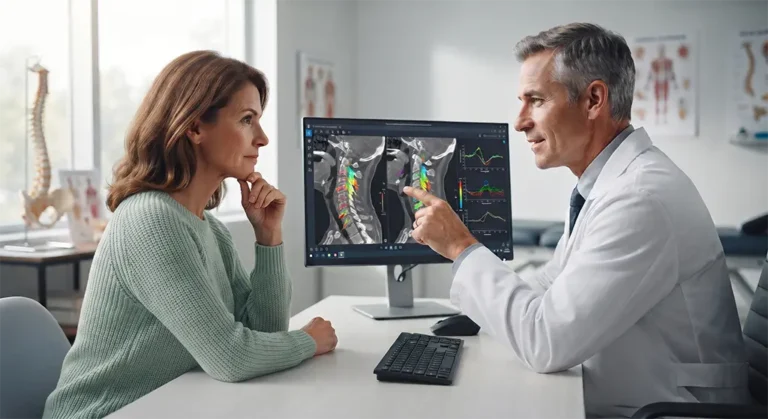
Before considering spine surgery, it is important to understand whether symptoms are structural, motion-based, or both. MRI and CT show anatomy, but they do not always explain movement-triggered pain, headaches, dizziness, or instability sensations. Digital Motion X-Ray (DMX) evaluates spinal motion in real time and can help document translation, angulation, asymmetry, and hinge patterns that may influence treatment planning and surgical conversations.
- MRI/CT show structure; DMX evaluates motion behavior.
- Motion findings may help clarify whether instability is part of the symptom pattern.
- DMX does not replace surgical consultation but may add useful functional information.
Last updated: April 14, 2026
Reviewed by: DMX Miami clinical team
Spine surgery decisions are serious. Patients often arrive at that conversation after months or years of pain, failed conservative care, injections, therapy, medications, or repeated flare cycles.
They may say:
- “My MRI shows something, but is it really the pain generator?”
- “My symptoms only happen when I move.”
- “I feel unstable, but my imaging is mild.”
- “I want to avoid surgery if possible.”
- “If I need surgery, I want the decision to be based on the best information.”
At DMX Miami, we see patients from Miami, Fort Lauderdale, Miami-Dade County, Broward County, and the Florida Keys, as well as visitors from the USA, Colombia, Chile, Argentina, Mexico, and the Caribbean who want clarity before major treatment decisions.
This blog is educational and not surgical advice. Surgical decisions must be made with qualified medical specialists.
Why anatomy alone may not answer the question
MRI and CT are essential. They can show discs, stenosis, fractures, nerve compression, spinal cord concerns, and other important findings.
But symptoms are not always explained by anatomy alone.
A person can have:
- abnormal MRI findings with no symptoms
- severe symptoms with mild imaging
- symptoms that occur only during motion
- pain that changes by position
- instability sensations that are not obvious on neutral imaging
This is why functional motion information can matter.
Structural problem vs motion problem
A structural problem is what the anatomy looks like. A motion problem is how the spine behaves.
Both can matter.
For example:
- A disc finding may be present, but the patient’s symptoms flare only during extension.
- A patient may have mild degeneration but severe instability sensations when turning.
- A patient may have neck pain, headaches, and dizziness that depend on motion arcs.
- A patient may have low back pain that appears during transitions, not at rest.
DMX helps evaluate motion behavior.
What DMX evaluates
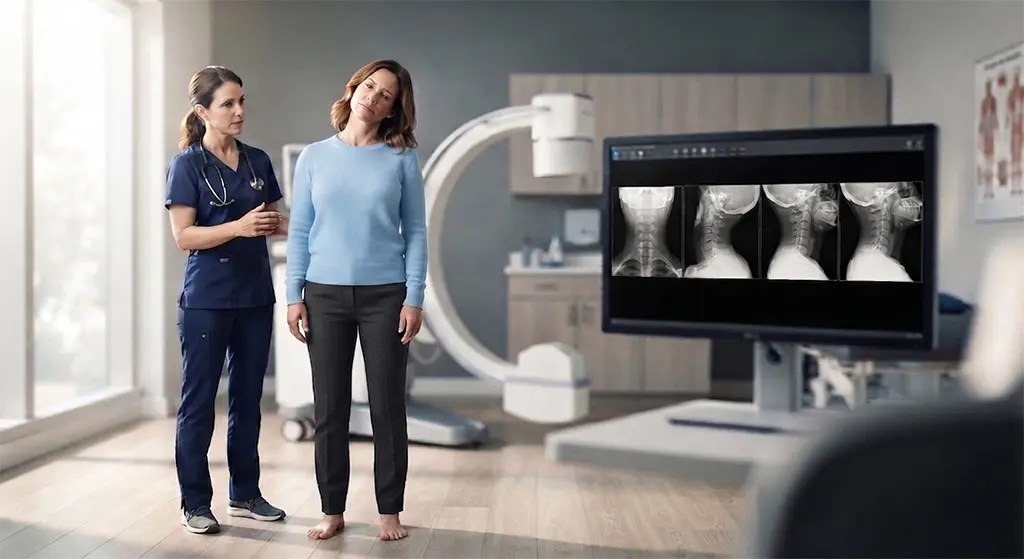
Digital Motion X-Ray is fluoroscopic video imaging performed during guided spinal motion. It can help evaluate:
- Translation: sliding between vertebrae
- Angulation: tilting between vertebrae
- Asymmetry: left vs right differences
- Hinge behavior: one segment moving too much
- Sequencing: whether motion is smooth or irregular
DMX does not replace MRI, CT, EMG, surgical consultation, or neurological evaluation. It complements them when motion and stability are key clinical questions.
When DMX may be useful before surgery discussions
DMX may add value when:
- symptoms are strongly motion-triggered
- static imaging does not match function
- instability is suspected
- symptoms relapse after conservative care
- pain changes with flexion/extension/rotation
- the patient feels “catching,” “clunking,” or “shifting”
- surgical level selection is uncertain
- the patient wants better functional documentation
How DMX can change the conversation
It may clarify instability patterns
If abnormal translation or angulation is present, that information may help providers understand whether instability is part of the clinical picture.
It may guide conservative care first
Some patients may still benefit from targeted stabilization care if motion findings reveal a pattern that has not been properly treated.
It may improve referral communication
A clearer motion report can help chiropractors, physical therapists, pain specialists, and surgeons communicate about the same functional problem.
It may help avoid treating the wrong level
Symptoms can be misleading. The painful area may be compensation, while the driver is elsewhere. Motion findings can help identify levels that deserve attention.
What patients should ask their provider
If you are considering surgery or trying to avoid it, ask:
- Do my symptoms match my MRI findings?
- Are my symptoms motion-triggered?
- Is instability suspected?
- Would motion imaging change the plan?
- Have I tried stabilization-focused care based on objective motion findings?
- What findings would make surgery more or less appropriate?
These questions do not replace expert medical judgment. They improve the discussion.
Practical preparation before DMX
Bring:
- MRI reports and images if available
- CT or X-ray reports
- prior treatment history
- symptom timeline
- exact motion triggers
- surgical opinions if already received
- list of functional limitations
The more specific the history, the more useful the motion interpretation.
Safety note
Seek urgent evaluation for progressive weakness, spinal cord symptoms, bowel/bladder changes, severe numbness, severe trauma, infection signs, or rapidly worsening neurological symptoms.
FAQs
Should I get DMX before spine surgery?
Not everyone needs DMX, but it may help when symptoms are motion-triggered or instability is suspected.
Does DMX replace MRI or CT?
No. DMX complements MRI/CT by evaluating motion behavior.
Can DMX help avoid surgery?
DMX does not decide surgery, but it may identify motion patterns that guide more targeted conservative care or improve surgical discussions.
What should I bring to a DMX evaluation?
Bring prior imaging, reports, treatment history, symptom triggers, and any surgical opinions.
References
- AAOS OrthoInfo: Spine pain and surgical decision education
- PubMed-indexed literature on spinal instability, dynamic imaging, and segmental biomechanics
Learn more: Treatment
Schedule your appointment today:Appointments
Call 305-275-7475 orbook your appointment online

Dr. Rodolfo Alfonso, D.C.
Dr. Mark N. Berry, D.C.
Sunset Chiropractic and Wellness
8585 Sunset Dr. STE 102
Miami, Florida 33143