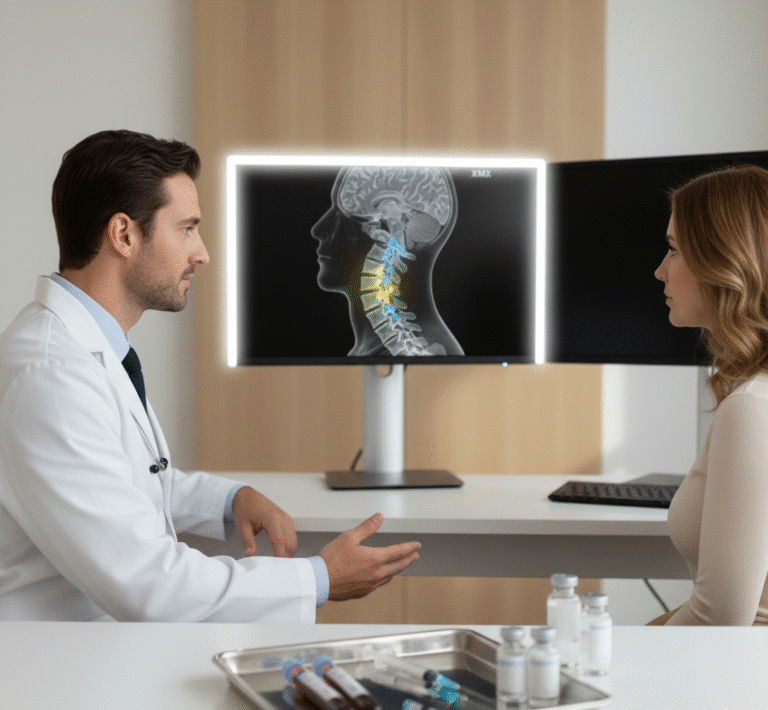
Why Your Regenerative Physician Needs a Clear Motion Map
Regenerative treatments like PRP (platelet-rich plasma) and stem cell–based therapies are increasingly used for spinal ligament and joint problems. But these powerful tools are only as precise as the diagnostic roadmap guiding them.
At DMX Miami, we work closely with regenerative and stem cell clinics in South Florida (Miami, Fort Lauderdale, Miami-Dade, Broward, Florida Keys) and with patients referred from across Florida, the USA, Central and South America (Colombia, Chile, Argentina, Mexico), and the Caribbean, to provide motion-based imaging that helps answer a key question: “Exactly which levels are unstable and need treatment?”
Why Regenerative Spine Treatments Need Precise Targeting
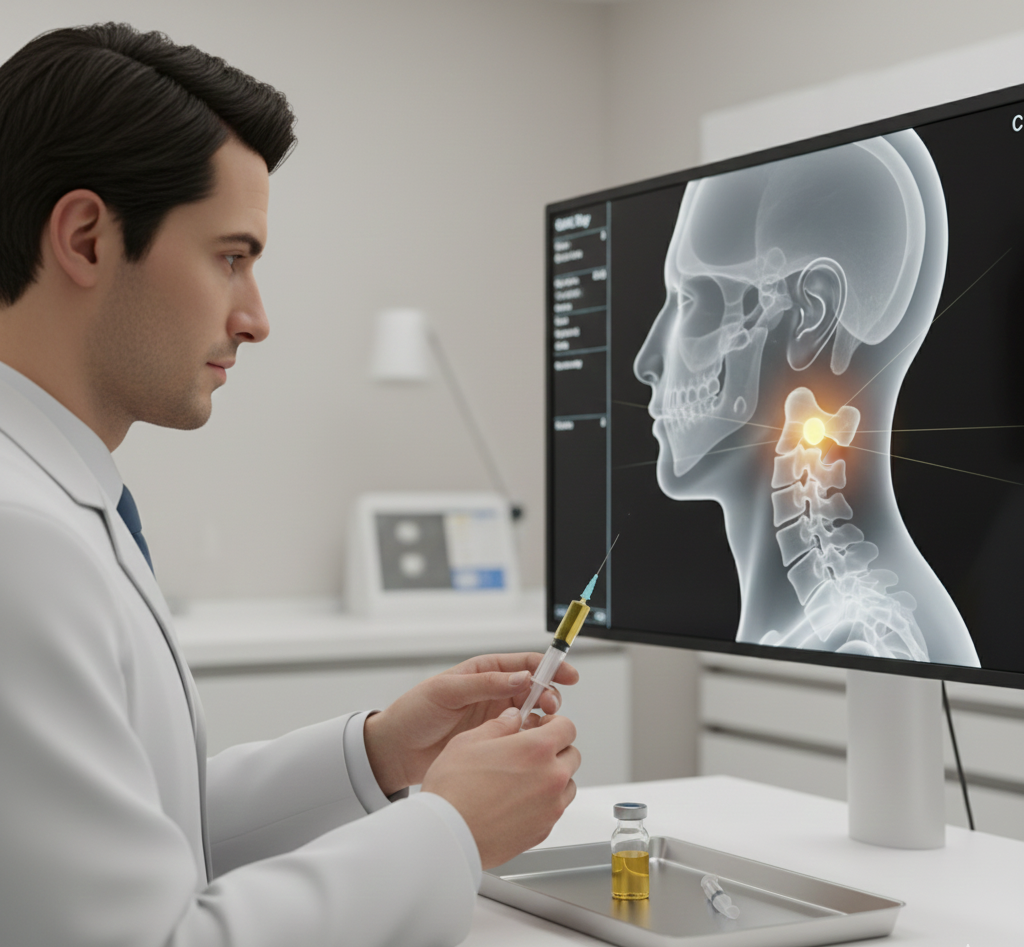
Regenerative therapies aim to:
- Strengthen or repair ligaments, joints, and supporting tissues.
- Improve long-term stability and function.
- Provide an alternative or complement to surgery and chronic pain medications.
For best results, injections should be:
- Directed at the correct levels and tissues.
- Guided by more than just static MRI or X-ray findings.
- Based on understanding how the spine moves and where it fails to stabilize.
That’s where Digital Motion X-Ray plays a unique role.
What Digital Motion X-Ray Adds Beyond MRI and Static X-Ray
MRI and standard X-rays are excellent for:
- Ruling out fractures, tumors, and major disc herniations.
- Evaluating discs, nerves, and gross alignment.
However, they are usually performed:
- Lying down or standing still.
- Without evaluating active flexion, extension, or rotation.
Digital Motion X-Ray (DMX) at DMX Miami:
- Records real-time spinal motion using fluoroscopic video.
- Measures abnormal translation and angulation between vertebrae.
- Highlights levels where ligaments may be lax or compromised.
- Helps distinguish segments that are too unstable from those that are relatively stable.
This functional view is invaluable when planning regenerative injections.
How Regenerative Doctors Use DMX Reports
Regenerative physicians and clinics use DMX findings to:
- Confirm suspected levels of ligamentous instability.
- Decide which segments may benefit most from PRP or stem cell treatments.
- Avoid over-treating areas that are already structurally sound.
- Document before-and-after changes in motion over time.
The more accurately the doctor can see the problem, the more precisely they can use regenerative tools to address it.
DMX and Post-Treatment Follow-Up
In some cases, DMX may be used:
- Before treatment to map instability.
- After a course of regenerative care to evaluate changes in motion.
While symptom improvement is the ultimate goal, seeing objective changes in stability can help:
- Guide further treatment decisions.
- Document progress for patients and referring providers.
- Support med-legal documentation when injuries were trauma-related.
DMX doesn’t replace clinical exams it enhances them.
A Team Approach: DMX Miami and Regenerative Clinics
We collaborate with:
- Regenerative and stem cell clinics in South Florida.
- Practices across Florida and the United States.
- Clinicians caring for patients traveling from Central and South America and the Caribbean.
Our role is to:
- Provide a clear, unbiased picture of motion and instability.
- Communicate findings in a way that’s useful for interventional planning.
- Support both conservative and regenerative care pathways.
We’re not here to push one treatment over another we’re here to provide the best possible map no matter which route you and your doctor choose.
Is DMX Right for Every Regenerative Candidate?
DMX may be especially appropriate when:
- The injury involved whiplash, impact, or sudden loading.
- Symptoms persist after standard care but imaging is “mild”.
- The regenerative provider suspects ligamentous involvement.
- The case involves personal injury or workers’ comp, where objective documentation matters.
Not every patient needs DMX, but for complex or unclear cases, it can be a game changer.
Why Regenerative Patients and Physicians Choose DMX Miami
Patients and providers rely on DMX Miami because we:
- Focus specifically on Digital Motion X-Ray of the spine.
- Understand the detailed needs of regenerative and stem cell clinicians.
- Provide structured, technically sound reports that integrate into treatment plans.
- Offer bilingual support for patients and clinics in English and Spanish.
Better Information In = Better Regenerative Outcomes Out
If you’re considering or already receiving PRP or stem cell treatments for your spine, motion-based imaging can help ensure that those treatments are focused where they’re needed most.
Learn more: Treatment
Schedule your appointment today: Appointments
Call 305-275-7475 or book your appointment online
Dr. Rodolfo Alfonso, D.C.
Dr. Mark N. Berry, D.C.
Sunset Chiropractic and Wellness
8585 Sunset Dr. STE 102
Miami, Florida 33143