
Digital Motion X-Ray and the Overlooked Middle Spine
When people think of accident injuries, they focus on:
- The neck (whiplash).
- The low back (sciatica).
But many patients end up with stubborn pain in the middle spine the thoracic region especially:
- Between the shoulder blades.
- Around the bra line area.
- With deep breaths or prolonged posture.
Patients from Miami, Fort Lauderdale, Miami-Dade, Broward, and the Florida Keys, plus visitors from Latin America and the Caribbean, often report:
- “My neck got treated, but the mid-back pain never left.”
- “Sitting at a desk makes it worse.”
- “It feels like a deep ache or burning between my shoulder blades.”
The thoracic spine is often under-evaluated because symptoms can mimic muscle strain but thoracic mechanics can matter more than most people realize.
Why the Thoracic Spine Is Commonly Missed
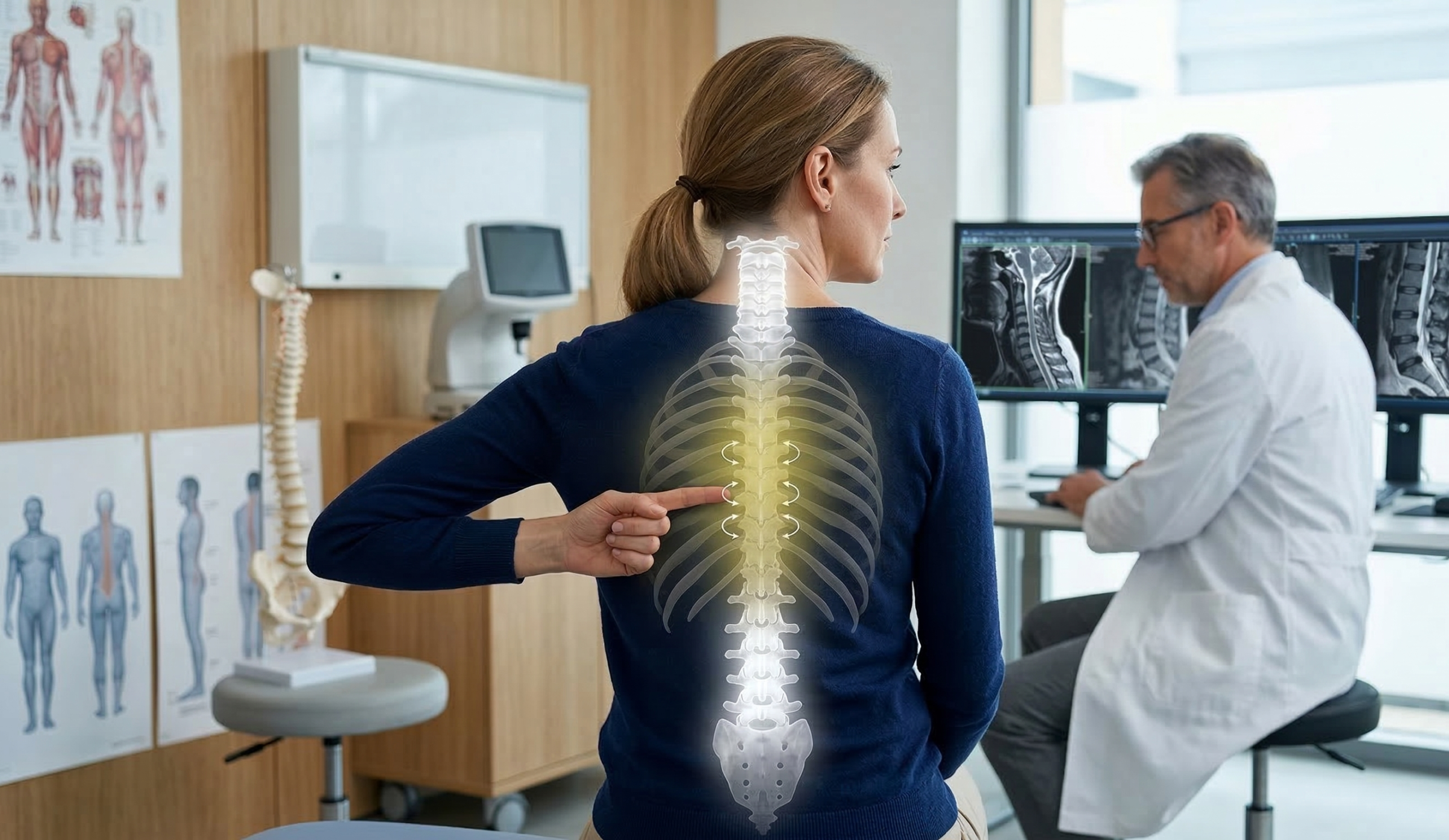
Thoracic pain is often dismissed as:
- “Posture.”
- “Stress tension.”
- “Just tight muscles.”
Sometimes that’s true. But after a collision, the thoracic spine can absorb forces from:
- Seatbelt restraints.
- Sudden forward motion.
- Bracing during impact.
- Whiplash forces traveling down the spine.
If thoracic segments move abnormally (too stiff or too mobile), it can create ongoing strain and pain.
Why Static Imaging May Not Explain Thoracic Pain
Standard thoracic X-rays and MRI can miss:
- Subtle segmental instability.
- Abnormal motion sequencing.
- Areas that “hinge” excessively during certain movements.
If pain is posture- and motion-driven, evaluating the thoracic spine in motion can provide important clarity.
How DMX Can Contribute
When appropriate and ordered, DMX can evaluate motion patterns that may include:
- Segmental motion behavior through guided movement.
- Whether certain thoracic segments move excessively or irregularly.
- How thoracic movement interacts with cervical and lumbar compensations.
This can help a provider determine whether a mid-back pain pattern is purely muscular or has a mechanical segment component.
Why This Matters for Rehab Planning
If thoracic mechanics are part of the problem, rehab may need to:
- Restore healthy thoracic mobility in specific areas.
- Stabilize hypermobile segments.
- Correct movement patterns that overload the mid-back.
- Coordinate neck + thoracic + rib mechanics for better breathing tolerance.
Instead of generic “stretch your upper back,” care becomes targeted.
When to Ask About Thoracic Evaluation
Consider discussing thoracic motion evaluation if:
- Mid-back pain started after a car accident or fall.
- Pain persists despite neck/lumbar treatment.
- Symptoms worsen with desk posture and driving.
- Deep breathing or rib movement increases discomfort.
The Mid-Back Can Be the Missing Link
A lot of chronic pain cases linger because only the neck or low back was addressed. If the thoracic spine is the “bridge” between them, ignoring it can stall progress. DMX can help provide motion-based insight in complex cases.
👉 Ask your provider if thoracic mechanics should be evaluated.
👉 Contact DMX Miami for information on motion-based spine imaging.
Learn more: Treatment
Schedule your appointment today:Appointments
Call 305-275-7475 orbook your appointment online

Dr. Rodolfo Alfonso, D.C.
Dr. Mark N. Berry, D.C.
Sunset Chiropractic and Wellness
8585 Sunset Dr. STE 102
Miami, Florida 33143