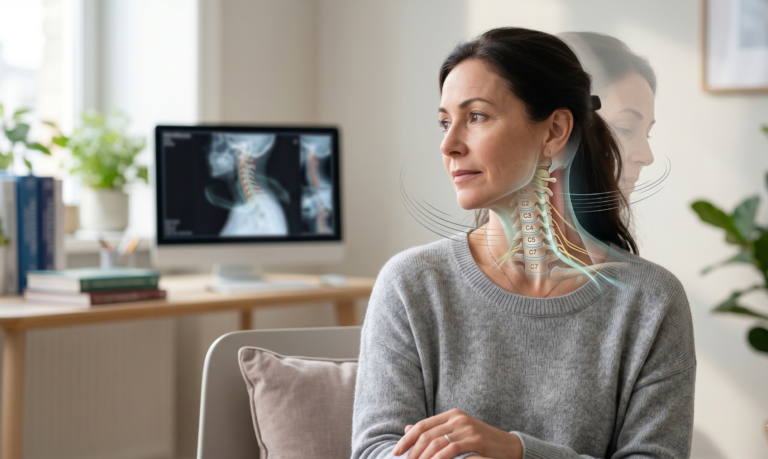
If dizziness reliably shows up when you turn your head especially while driving, scanning
crowds, or checking blind spots the problem may be motion-triggered rather than constant.
Digital Motion X-Ray (DMX) evaluates cervical spine motion in real time and can help document
whether abnormal movement patterns may be contributing, particularly when static imaging
doesn’t match your symptoms.
- Dizziness that is triggered by head turning often points to a motion-sensitive pattern.
- MRI/CT and standard X-rays are valuable but mostly static; DMX evaluates motion behavior
(translation/angulation). - When motion is the trigger, identifying the pattern can help providers tailor stabilization,
ergonomics, and rehab progression to reduce trial-and-error.
Last updated: April 14, 2026
Reviewed by: DMX Miami clinical team
In South Florida Miami, Fort Lauderdale, Miami-Dade County, Broward County, and the Florida
Keys people spend a lot of time driving, scanning traffic, and turning their head quickly.A common complaint we hear is very specific: “I’m okay until I turn my head.” Others say,
“Checking my blind spot makes me dizzy,” or “Turning quickly in a store makes me feel off.”
We also see visitors traveling through Florida from the USA, and from Colombia, Chile,
Argentina, Mexico, and the Caribbean. Many notice that travel days, crowds, and busy visual
environments make symptoms flare. When dizziness is position-dependent or
movement-dependent, it’s reasonable to ask: is cervical motion a factor?
Why head turning can trigger dizziness
1) Balance uses a three-signal system
Your brain uses a mix of signals to understand head position and balance: the inner ear
(vestibular system), vision, and proprioception (position feedback) from the neck and body. If
one signal is “noisy,” the brain can feel overwhelmed especially during motion.
2) Neck proprioception can be disrupted after injury
After whiplash or a fall, the neck’s sensors and stabilizers can become irritated or protective.
Even if pain decreases, motion sensitivity can linger. This doesn’t automatically mean severe
instability, but it does mean the movement pattern deserves evaluation.
3) Driving and crowds stack triggers
Head turning while driving isn’t pure rotation. It usually includes forward head posture, subtle
extension, muscle bracing, and prolonged sitting load. In crowds, your eyes are constantly
tracking movement while your head turns and your neck stabilizers are working. If dizziness
spikes in the same arc repeatedly, mechanics may be contributing.
Why static imaging may not match motion-triggered dizziness
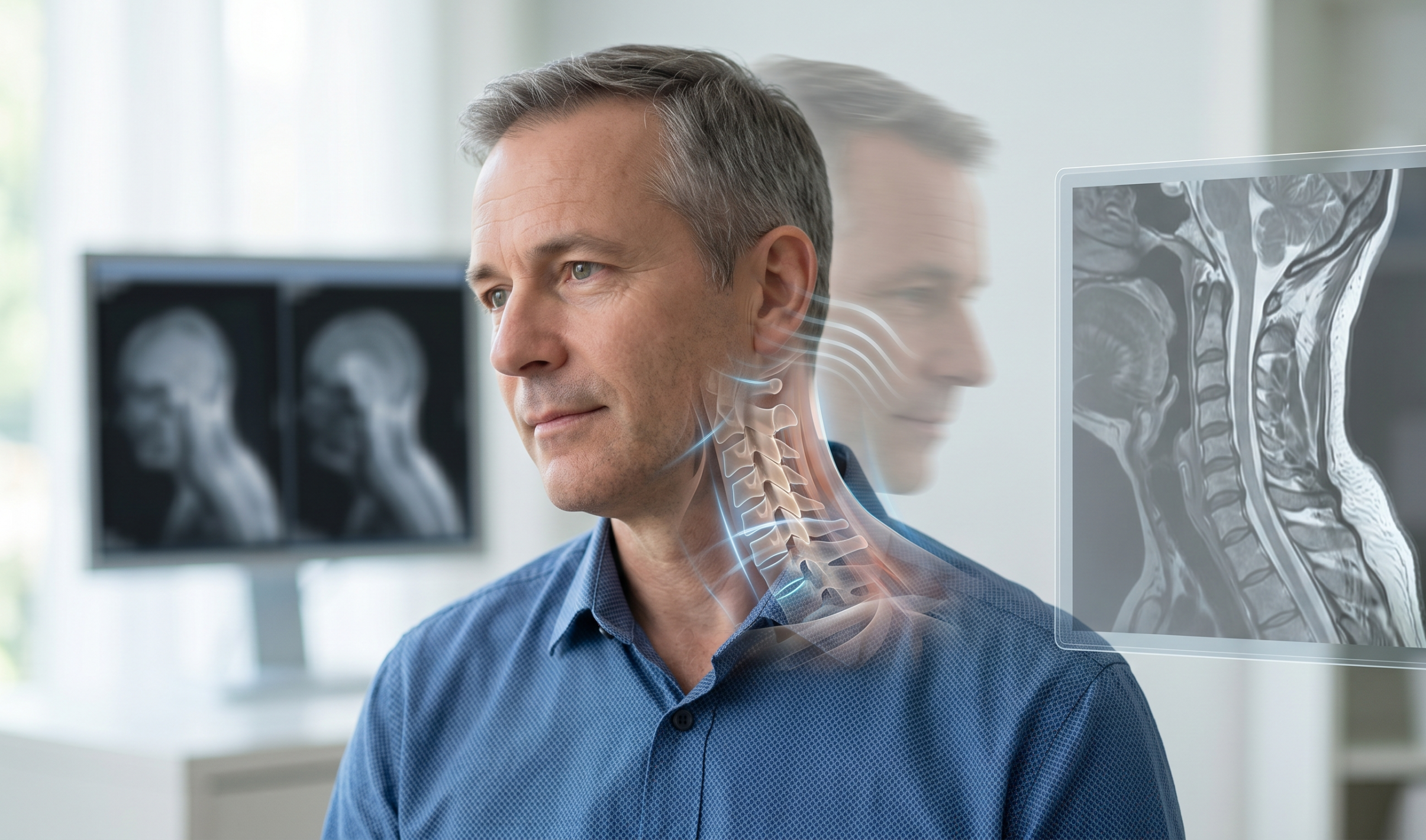
MRI and CT are excellent tools. Standard X-rays can be very helpful. But these tests are often
performed in still positions and in limited snapshots. They may not capture the continuous
movement arc that triggers symptoms. That’s why some people feel dismissed by “normal”
results even though their real-life trigger is repeatable.
What DMX evaluates in motion
Digital Motion X-Ray (DMX) is fluoroscopic video X-ray used to observe spinal segments during
guided motion. In the cervical spine, DMX can help assess:
- Translation: sliding movement between vertebrae.
- Angulation: tilting movement between vertebrae.
- Symmetry: left vs right behavior.
- Hinge patterns: one segment doing too much while others do too little.
DMX does not replace MRI. It answers a different question: what happens during motion?
A practical symptom pattern checklist (general guidance)
Dizziness may be more “motion-linked” when:
- Symptoms are reliably triggered by turning left or right.
- Symptoms worsen with extension + rotation (looking up while turning).
- Driving or scanning environments (grocery stores, airports) provoke symptoms.
- Neck pain, stiffness, or “heavy head” fatigue accompanies the dizziness.
- Symptoms improve when you reduce end-range turning and improve posture breaks.
Dizziness may be more “inner-ear linked” when:
- Room spinning occurs with lying down or rolling in bed.
- There is a recent ear infection or hearing change.
- The main trigger is positional change rather than neck motion
These patterns can overlap. Many patients benefit from coordinated evaluation.
How DMX findings can change treatment planning
When motion data is available, providers can more confidently decide:
- Whether to prioritize stabilization and motor control before aggressive stretching.
- Which arcs to limit temporarily (rotation + extension, fast turning, repeated end-range checks).
- Which exercises may be helpful vs aggravating.
- How to structure progressions so dizziness triggers reduce over time Instead of guessing, the plan can match your triggers.
Instead of guessing the plan can match your triggers.
Practical steps while awaiting evaluation (general
guidance)
- Track your trigger map: left vs right turning, speed, extension involvement, driving
duration, screen time. - Reduce repeated end-range snaps; use torso turning and mirror adjustments while
driving. - Add posture breaks for driving/desk triggers.
- Avoid extreme heat on numb areas; prioritize safety.
When dizziness needs urgent medical evaluation
Seek urgent care if you have new weakness, facial droop, speech changes, severe “worst
headache of life,” chest pain, fainting, or other concerning neurological changes.
FAQs
Can turning my head cause dizziness from the neck?
In some cases, yes especially when dizziness tracks tightly with cervical motion and posture
triggers.
Why can my MRI be normal if I’m dizzy?
MRI is static. Motion-triggered symptoms can persist even when static structure looks
reassuring.
What does DMX show that regular X-rays don’t?
DMX shows continuous motion behavior through movement arcs, including translation and
angulation patterns.
Do I still need vestibular or ENT evaluation?
Sometimes, yes. Many cases benefit from coordinated evaluation depending on symptoms.
References
- Cleveland Clinic: Cervical vertigo / cervicogenic dizziness education
- PubMed-indexed literature on cervicogenic dizziness and cervical proprioception
Footer: DMX Miami serves patients in Miami, Fort Lauderdale, Miami-Dade, Broward, the
Florida Keys, Florida, the USA, and visitors from Colombia, Chile, Argentina, Mexico, and the
Caribbean.
Learn more: Treatment
Schedule your appointment today:Appointments
Call 305-275-7475 orbook your appointment online

Dr. Rodolfo Alfonso, D.C.
Dr. Mark N. Berry, D.C.
Sunset Chiropractic and Wellness
8585 Sunset Dr. STE 102
Miami, Florida 33143