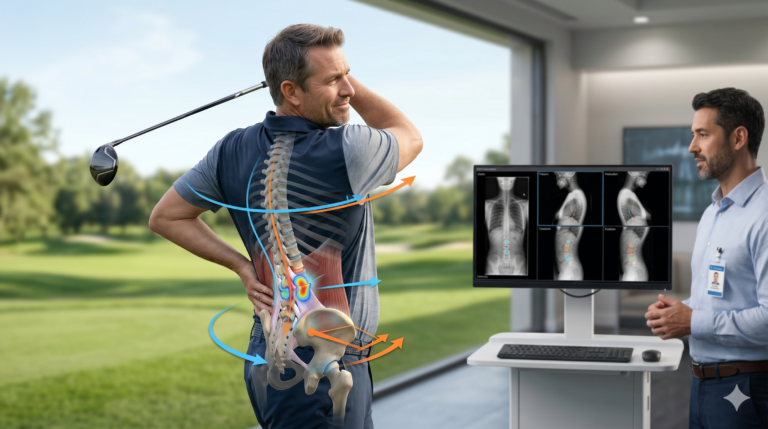
Golf, tennis, pickleball, and other rotational sports can expose motion-based instability in the spine. If pain appears during rotation, follow-through, serving, swinging, or returning upright, the driver may be abnormal translation, angulation, or hinge behavior. Digital Motion X-Ray (DMX) evaluates spinal motion in real time to help guide stabilization, sport-specific rehab, and safer return to play.
- Rotational sports stress the spine through combined motion, speed, and load.
- Pain during swing or follow-through can reflect instability, not just tight muscles.
- DMX can help identify hinge segments and guide stabilization-focused sport rehab.
Last updated: April 14, 2026
Reviewed by: DMX Miami clinical team
South Florida is full of rotational athletes. Golf, tennis, pickleball, paddle sports, baseball, and fitness training are common in Miami, Fort Lauderdale, Miami-Dade County, Broward County, and the Florida Keys. We also see athletes and active adults traveling from the USA, Colombia, Chile, Argentina, Mexico, and the Caribbean who want to stay active while addressing persistent spine pain.
A common complaint sounds like:
- “My back hurts during my golf swing.”
- “Serving in tennis triggers my neck or back.”
- “Pickleball rotation flares my low back.”
- “I feel fine walking, but rotation gets me.”
- “I can train, but follow-through causes a catch.”
When pain is tied to rotation, the issue may not be simple tightness. It may be motion control.
Why rotational sports stress the spine
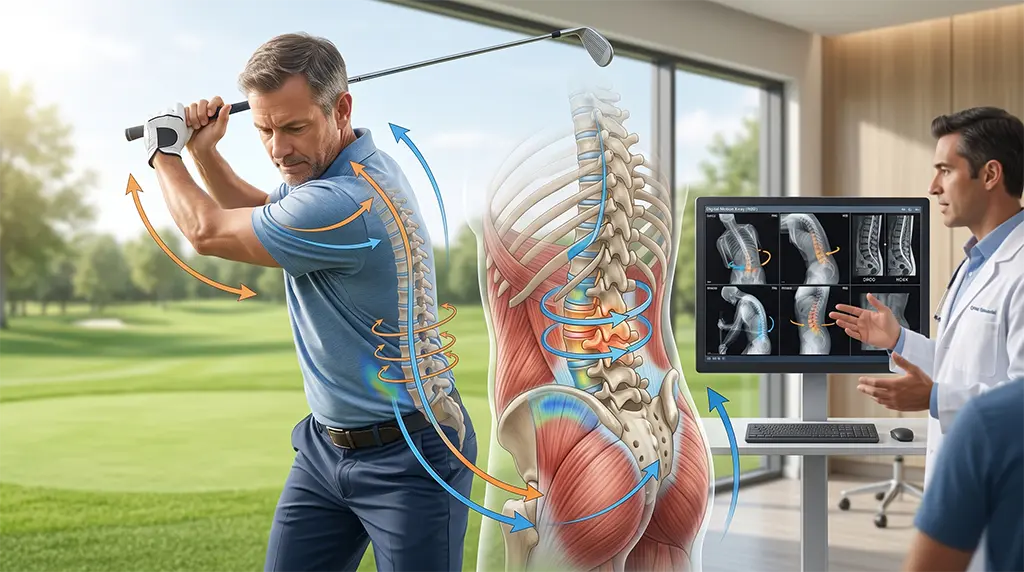
Rotational sports combine several forces:
- Rotation
- Extension
- Side bending
- Speed
- Bracing
- Ground reaction force
- Follow-through deceleration
That combination can expose instability more than normal daily activity.
Why pain during rotation matters
If pain occurs consistently during one part of the swing or serve, the body is giving you a mechanical clue. The painful arc often matters more than the general location of pain.
For example:
- Pain during backswing may involve one motion pattern
- Pain during follow-through may involve another
- Pain after play may reflect fatigue and delayed guarding
- Pain only with speed may reveal stability demand
A generic stretching plan may not fix a motion-control problem.
The hinge segment in sports
A hinge segment is a spinal level that takes too much motion while other segments remain stiff. In rotational sports, the hinge segment may be overloaded repeatedly.
Signs may include:
- One-sided low back pain
- Catching during rotation
- Pain during follow-through
- Relief with rest but flare when returning to sport
- Recurring “same spot” irritation
- Symptoms that return despite strengthening
Why MRI may not match sport pain
MRI is useful for structural findings, but it is not a golf swing, tennis serve, or pickleball rotation. It is usually performed lying down and still.
A sport-specific flare may depend on:
- Motion sequencing
- Dynamic instability
- Rotation + extension
- Load transfer from hips to spine
- Speed and fatigue
Static imaging may show mild findings while the athlete has major functional limitation.
How DMX evaluates motion
Digital Motion X-Ray records spinal motion during guided arcs. Providers may evaluate:
- Translation, or sliding between vertebrae
- Angulation, or tilting between vertebrae
- Segmental asymmetry
- Hinge behavior
- Motion sequencing
DMX does not recreate a full golf swing, but it can identify abnormal segment behavior that may become relevant during sport-specific loading.
How DMX can change sports rehab
Stabilization before speed
If motion instability is present, the athlete may need controlled stabilization before returning to high-speed rotation.
Better exercise selection
Some rotational exercises may feed the hinge pattern. Others may improve control. DMX helps providers decide where to start.
Hip-spine load sharing
Many rotational athletes overload the lumbar spine because hips or thoracic spine are not sharing motion well. A better plan trains the whole chain.
Return-to-play milestones
Instead of returning based only on pain reduction, milestones can include:
- Rotation tolerance
- Follow-through tolerance
- No delayed flare after play
- Improved endurance
- Better control under fatigue
Practical steps while awaiting evaluation
- Stop repeatedly testing the painful swing
- Reduce speed before reducing all activity
- Track which phase hurts: setup, backswing, impact, follow-through
- Avoid heavy rotation under fatigue
- Train hip control and trunk endurance conservatively
- Note whether pain is immediate or delayed
Why this matters for active adults
Many people are not professional athletes, but sport is part of identity and health. In South Florida, staying active matters. A motion-based plan can help patients avoid the cycle of rest, return, flare, repeat.
Safety note
Seek medical evaluation if sports-related pain includes progressive weakness, radiating symptoms, severe numbness, trauma, or worsening neurological signs.
FAQs
Can golf or tennis reveal spinal instability?
Yes. Rotational sports can expose motion-control problems that are not obvious during walking or sitting.
Why does my back hurt only during rotation?
Rotation combines speed, load, and stability demand, which can stress hinge segments.
What does DMX add for athletes?
DMX evaluates real-time translation, angulation, asymmetry, and hinge behavior during guided spinal motion.
Does DMX replace sports rehab?
No. DMX helps make sports rehab more targeted when motion instability is suspected.
References
- AAOS OrthoInfo: Low back pain and sports injury education
- PubMed-indexed literature on lumbar biomechanics and rotational spine loading
Learn more: Treatment
Schedule your appointment today:Appointments
Call 305-275-7475 orbook your appointment online

Dr. Rodolfo Alfonso, D.C.
Dr. Mark N. Berry, D.C.
Sunset Chiropractic and Wellness
8585 Sunset Dr. STE 102
Miami, Florida 33143