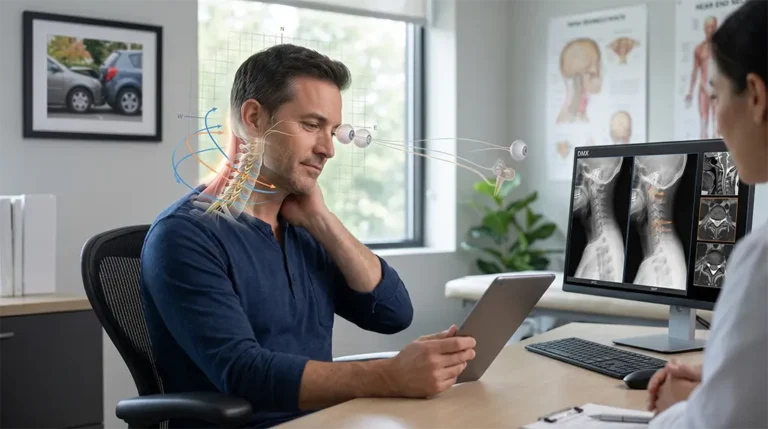
Eye pressure, visual strain, headaches, and screen intolerance after whiplash can sometimes overlap with upper cervical motion problems. When symptoms worsen with head position, neck fatigue, driving, or looking up/down, Digital Motion X-Ray (DMX) can evaluate cervical motion in real time and help identify translation, angulation, asymmetry, or hinge patterns that may contribute to persistent symptoms.
- Visual strain after whiplash can overlap with cervical proprioception, headaches, and upper-neck mechanics.
- Static imaging may not capture motion-based cervical instability or hinge behavior.
- DMX can help guide stabilization-focused care and coordinated evaluation when symptoms are motion-triggered.
Last updated: April 14, 2026
Reviewed by: DMX Miami clinical team
After whiplash, some symptoms do not feel like “neck pain” at all. Patients may describe:
- Eye pressure
- Visual fatigue
- Trouble reading
- Headache behind the eyes
- Screen intolerance
- Dizziness in busy environments
- Pressure that worsens when looking down or up
At DMX Miami, we see this in patients from Miami, Fort Lauderdale, Miami-Dade County, Broward County, and the Florida Keys, as well as visitors from the USA, Colombia, Chile, Argentina, Mexico, and the Caribbean. Many have already had eye exams, brain imaging, or cervical MRI, but the symptoms persist.
Important: eye pressure and visual changes can have eye, neurological, vascular, and medical causes. This blog is educational. Sudden vision loss, severe eye pain, neurological changes, or severe headache require urgent medical evaluation.
Why visual symptoms can overlap with neck injury

The neck helps orient the head in space. The brain integrates visual input, vestibular input, and cervical proprioception. If the neck is injured, guarded, or unstable, that sensory integration can become more difficult.
This may contribute to symptoms such as:
- Visual fatigue
- Trouble focusing
- Headache with reading
- Dizziness with screen use
- Eye pressure that tracks with neck posture
The neck may not be the only cause, but it can be a contributing factor.
Why the upper cervical spine matters
The upper cervical spine has a high concentration of motion and sensory input. It helps control head position and fine orientation. After whiplash, the upper neck may become guarded or motion-sensitive.
Patients may notice:
- Base-of-skull headaches
- Pressure behind one or both eyes
- Symptoms worse with looking up
- Symptoms worse with looking down at screens
- Temporary relief with traction or specific positions
- Symptoms that build by late afternoon
These patterns suggest that cervical mechanics should be considered.
Why static imaging may not explain visual strain
MRI and CT are valuable, but they are still images. If symptoms are triggered by motion, posture, or fatigue, static imaging may not show the driver.
Static imaging may not capture:
- Upper cervical translation
- Abnormal angulation
- Rotation asymmetry
- Hinge behavior
- Instability that appears only during movement
How DMX evaluates cervical motion
Digital Motion X-Ray is fluoroscopic video imaging performed during guided motion. For upper cervical and cervical cases, DMX can help evaluate:
- Translation
- Angulation
- Left-right asymmetry
- Hinge segments
- Motion sequencing
- How movement is shared across the cervical spine
DMX does not replace eye care, neurological evaluation, vestibular testing, MRI, or CT. It complements evaluation when motion behavior appears relevant.
When visual symptoms may be motion-linked
Consider cervical motion evaluation when visual strain:
- Began after whiplash or a fall
- Worsens with screen posture
- Worsens with looking up or down
- Comes with base-of-skull headache
- Comes with dizziness or neck fatigue
- Improves temporarily with cervical support, traction, or posture change
How DMX findings can change care
Stabilization-first rehab
If upper cervical or cervical motion patterns are abnormal, care may prioritize controlled stabilization and endurance rather than aggressive stretching.
Screen tolerance planning
A plan may include timed screen breaks, device height changes, reduced sustained flexion, and gradual exposure.
Safer manual therapy
Motion data can help providers choose techniques that avoid overstressing unstable segments.
Coordinated referral
If visual symptoms are significant, coordination with eye care, neurology, or vestibular providers may be appropriate.
Practical steps while awaiting evaluation
- Track screen tolerance in minutes
- Note whether looking up or down changes eye pressure
- Track headache location
- Take posture breaks before symptoms peak
- Avoid repeatedly testing painful end-range motion
- Use larger screens and reduce phone flexion when possible
Safety note
Seek urgent evaluation for sudden vision loss, severe eye pain, new neurological symptoms, severe headache, fainting, or facial weakness.
FAQs
Can whiplash cause visual strain?
Whiplash can contribute to symptoms that overlap with visual strain, especially when cervical proprioception and neck mechanics are involved.
Can the upper neck cause pressure behind the eyes?
In some cases, upper cervical irritation and headache patterns can refer pressure toward the eye region, but eye and neurological causes must be evaluated.
What does DMX show?
DMX evaluates real-time cervical motion, including translation, angulation, asymmetry, and hinge behavior.
Does DMX replace an eye exam?
No. DMX complements care when cervical motion appears to contribute to symptoms.
References
- Cleveland Clinic: Whiplash, neck pain, and cervicogenic headache education
- PubMed-indexed literature on cervical proprioception, whiplash-associated disorders, and cervicogenic symptoms
Learn more: Treatment
Schedule your appointment today:Appointments
Call 305-275-7475 orbook your appointment online

Dr. Rodolfo Alfonso, D.C.
Dr. Mark N. Berry, D.C.
Sunset Chiropractic and Wellness
8585 Sunset Dr. STE 102
Miami, Florida 33143