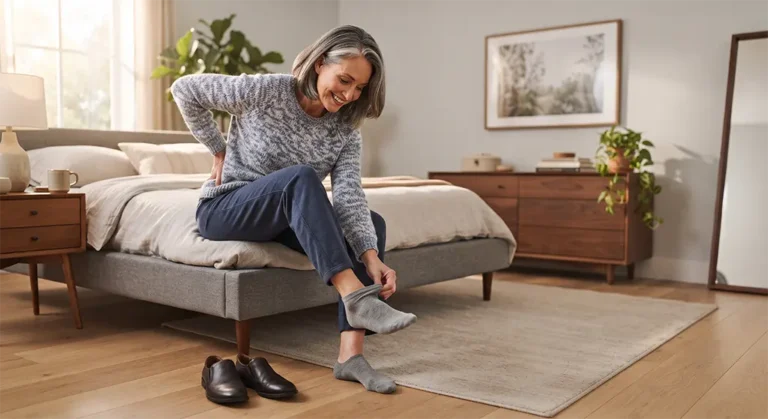
Putting on shoes or socks requires lumbar flexion, hip mobility, pelvic control, balance, and sometimes rotation. If this simple daily task triggers low back pain, buttock pain, catching, or spasm, the issue may involve lumbar instability or poor motion sharing between the hips and spine. Digital Motion X-Ray (DMX) evaluates lumbar motion in real time and can help identify translation, angulation, hinge behavior, asymmetry, or instability patterns that static imaging may miss.
- Putting on shoes or socks is a daily test of lumbar flexion, hip motion, and stability.
- Pain during this task may suggest hinge behavior or lumbar motion sensitivity.
- DMX can help guide stabilization-focused care and safer movement strategies.
Last updated: April 14, 2026
Reviewed by: DMX Miami clinical team
Some of the most frustrating back pain happens during ordinary tasks. Putting on shoes or socks should be easy, but many patients dread it.
At DMX Miami, we see this in patients from Miami, Fort Lauderdale, Miami-Dade County, Broward County, and the Florida Keys, as well as visitors from the USA, Colombia, Chile, Argentina, Mexico, and the Caribbean.
Patients often say:
- “My back catches when I put on socks.”
- “Tying my shoes hurts more than walking.”
- “I have to sit down to put on shoes.”
- “Bending forward triggers a spasm.”
- “One hip feels tight, then my back grabs.”
- “My MRI was mild, but I still cannot do basic tasks.”
This pattern matters because shoe-and-sock pain is not random. It is a repeatable movement problem.
Why putting on shoes stresses the low back
This task usually combines several movements:
- bending forward
- hip flexion
- pelvic rotation
- trunk flexion
- reaching
- balance
- sometimes twisting
- returning upright
If the hips move well and the lumbar spine is stable, the task is manageable. If hip motion is limited or a lumbar segment is unstable, the low back may take too much stress.
The hip-spine connection
The hips and lumbar spine share motion. If the hips are stiff, the lumbar spine may compensate. If the lumbar spine is unstable, the body may guard and restrict movement.
A patient may feel:
- low back pulling
- buttock tightness
- sharp catch
- one-sided pain
- pain returning upright
- spasm after bending
- stiffness for the first few steps afterward
The painful area may be the low back, but the movement problem may involve both hips and lumbar segments.
Why one side may be worse
Putting on the right shoe may feel different from putting on the left. One hip may have less mobility. One lumbar side may be more sensitive. The patient may rotate or side-bend more in one direction.
This asymmetry is clinically useful. It helps identify whether the problem is side-specific, hip-driven, lumbar-driven, or mixed.
Why static imaging may not explain it
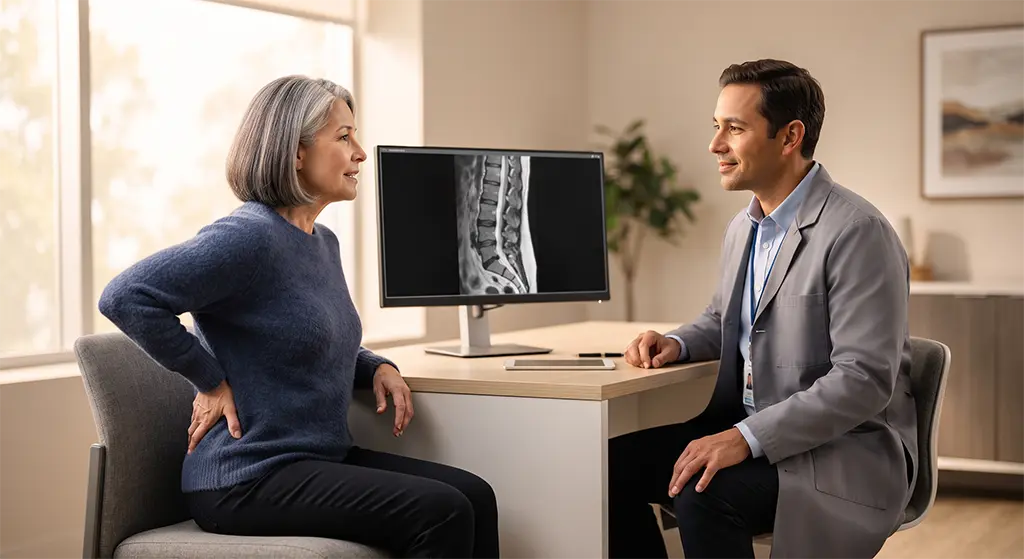
MRI and X-rays can show structure, but putting on shoes is dynamic. It happens during bending, reaching, balance, and returning upright.
Static imaging may not show:
- lumbar translation during flexion
- abnormal angulation
- hinge behavior
- poor sequencing returning upright
- asymmetry between directions
- instability that appears only during motion
A patient may have a “normal” or mild MRI but still have pain during repeated daily tasks.
How Digital Motion X-Ray helps
Digital Motion X-Ray evaluates spinal motion using fluoroscopic video imaging. In lumbar cases, DMX may assess:
- Translation: sliding between vertebrae
- Angulation: tilting between vertebrae
- Hinge behavior: one level moving excessively
- Sequencing: whether motion is smooth or irregular
- Asymmetry: differences between movement directions
DMX does not replace MRI, CT, orthopedic evaluation, or hip evaluation. It complements them when the question is motion and stability.
How DMX findings can change care
Stabilization-first rehab
If instability is present, rehab may prioritize trunk control, hip coordination, and safe flexion exposure.
Task-specific training
Patients can train the exact movement that hurts: sitting to put on socks, using a footrest, hip hinging, or avoiding loaded twisting.
Hip-spine coordination
The plan may include hip mobility and glute control so the lumbar spine does not overcompensate.
Safer daily strategies
Instead of repeatedly irritating the back every morning, patients can modify the movement while stability improves.
Practical steps while awaiting evaluation
- Sit down to put on shoes or socks
- Bring the foot up instead of bending the spine down
- Use a shoehorn if needed
- Avoid twisting while bent forward
- Use a footrest
- Move slowly when returning upright
- Track whether one side is worse
- Avoid forcing painful stretch positions during flare periods
Safety note
Seek medical evaluation if low back pain includes progressive weakness, numbness, bowel/bladder changes, severe trauma, fever, unexplained weight loss, or inability to walk.
FAQs
Why does my back hurt when putting on socks?
The task combines lumbar flexion, hip motion, reaching, and balance, which can stress unstable or motion-sensitive segments.
Can hip stiffness cause low back pain when tying shoes?
Yes. If hip motion is limited, the lumbar spine may compensate.
What does DMX show?
DMX evaluates real-time lumbar translation, angulation, hinge behavior, sequencing, and asymmetry.
Does DMX replace hip or MRI evaluation?
No. DMX complements other evaluations when motion-based lumbar instability is suspected.
References
- AAOS OrthoInfo: Low back pain and mechanical movement education
- PubMed-indexed literature on lumbar instability and segmental biomechanics
Footer: DMX Miami serves patients in Miami, Fort Lauderdale, Miami-Dade, Broward, the Florida Keys, Florida, the USA, and visitors from Colombia, Chile, Argentina, Mexico, and the Caribbean.
Learn more: Treatment
Schedule your appointment today:Appointments
Call 305-275-7475 orbook your appointment online

Dr. Rodolfo Alfonso, D.C.
Dr. Mark N. Berry, D.C.
Sunset Chiropractic and Wellness
8585 Sunset Dr. STE 102
Miami, Florida 33143