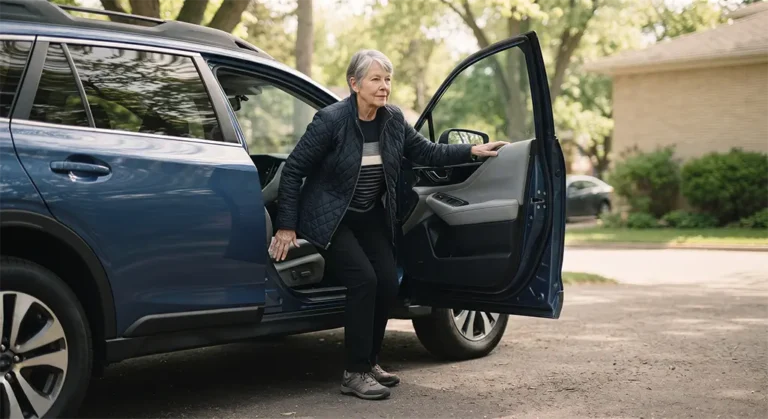
Getting in and out of a car requires bending, twisting, hip motion, pelvic control, and lumbar stabilization. If your low back catches, spasms, or locks when entering or exiting a vehicle, the issue may involve lumbar instability or poor hip-spine coordination. Digital Motion X-Ray (DMX) evaluates lumbar motion in real time and can help identify translation, angulation, hinge behavior, asymmetry, or instability patterns that static imaging may not show.
- Vehicle entry and exit combine twisting, bending, and standing from a seated position.
- Pain during this transition may reveal lumbar hinge behavior or motion sensitivity.
- DMX can help guide stabilization-focused rehab and safer movement strategies.
Last updated: April 14, 2026
Reviewed by: DMX Miami clinical team
Many patients can sit, stand, and walk separately, but getting in or out of a car triggers sharp low back pain. This is especially common with low sports cars, high SUVs, trucks, rideshares, rental cars, and tight parking spaces.
At DMX Miami, we see this in patients from Miami, Fort Lauderdale, Miami-Dade County, Broward County, and the Florida Keys, and in visitors from the USA, Colombia, Chile, Argentina, Mexico, and the Caribbean who drive rental cars, use rideshares, or travel through South Florida.
Patients often say:
- “My back catches getting out of the car.”
- “Low cars are the worst.”
- “SUVs make me twist awkwardly.”
- “After sitting, standing from the car hurts.”
- “I feel a sharp grab in my low back.”
- “My MRI does not explain why this daily movement is so painful.”
This symptom is important because vehicle transitions are real-life tests of lumbar control.
Why cars trigger low back pain
Getting in and out of a car combines:
- hip flexion
- trunk rotation
- lumbar flexion
- pelvic shifting
- standing from sitting
- bracing
- sometimes carrying bags
- limited space
The body must coordinate movement quickly. If a lumbar segment is unstable, the transition can trigger pain.
Why getting out often hurts more than getting in
Getting out of a car is harder because the spine goes from supported sitting to active standing. After sitting, the lumbar spine may be stiff, the hips may be flexed, and the stabilizers may need to re-engage quickly.
A common pattern:
- Patient sits during drive
- Low back stiffens
- Hips tighten
- Patient twists to exit
- A lumbar segment catches
- First few steps feel painful
- Walking gradually loosens symptoms
This transition pattern can suggest motion-control problems.
Low cars vs high SUVs
Low cars
Low cars require deeper hip flexion and more effort to rise. Patients often twist while pushing up.
High SUVs or trucks
High vehicles may require stepping down, rotating, and bracing. If the patient lands unevenly, the low back may flare.
Tight parking spaces
Tight spaces make the movement more awkward. The patient may twist more because the door cannot open fully.
Why static imaging may not explain vehicle pain
MRI and standard X-rays can show structure, but getting out of a car is dynamic. It involves sitting, twisting, bending, standing, and first-step loading.
Static imaging may not show:
- lumbar translation during movement
- abnormal angulation
- hinge behavior
- asymmetry
- instability during flexion-extension
- poor sequencing during transitions
A patient can have mild imaging but major pain with this specific task.
How Digital Motion X-Ray helps
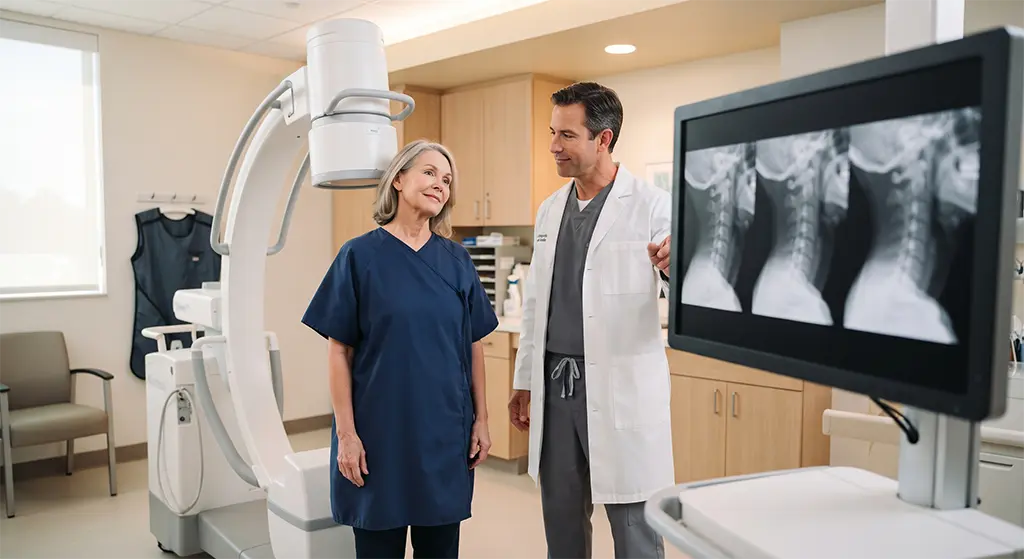
Digital Motion X-Ray uses fluoroscopic video imaging to evaluate spinal motion. In lumbar cases, DMX may assess:
- Translation: sliding between vertebrae
- Angulation: tilting between vertebrae
- Hinge behavior: one segment moving excessively
- Sequencing: whether movement is smooth or irregular
- Asymmetry: differences between directions
DMX does not replace MRI, CT, orthopedic evaluation, or neurological evaluation. It complements them when symptoms are motion-triggered.
How DMX findings can change care
If abnormal motion is found, the plan may include:
- lumbar stabilization
- hip mobility and control
- sit-to-stand training
- vehicle transition mechanics
- avoiding loaded twisting
- driving break strategies
- safer lifting after driving
- work and travel modifications
The goal is to make daily transitions safer and less painful.
Practical steps while awaiting evaluation
- Turn your whole body before standing
- Bring both legs out together when possible
- Avoid twisting while rising
- Scoot to the edge of the seat first
- Use your legs and hands for support
- Pause before walking after long drives
- Avoid lifting bags immediately after exiting
- Track which vehicles are worst
Safety note
Seek medical evaluation if low back pain includes progressive weakness, numbness, bowel/bladder changes, fever, severe trauma, unexplained weight loss, or inability to walk.
FAQs
Why does my back hurt getting out of the car?
The movement combines sitting stiffness, twisting, bending, and standing, which can stress motion-sensitive lumbar segments.
Are low cars worse for back pain?
They can be because they require deeper hip flexion and more effort to stand.
What does DMX show?
DMX evaluates real-time lumbar translation, angulation, hinge behavior, asymmetry, and motion sequencing.
Does DMX replace MRI?
No. DMX complements MRI/CT/X-ray when pain is motion- or transition-triggered.
References
- AAOS OrthoInfo: Low back pain and mechanical triggers
- PubMed-indexed literature on lumbar instability and dynamic spinal biomechanics
Footer: DMX Miami serves patients in Miami, Fort Lauderdale, Miami-Dade, Broward, the Florida Keys, Florida, the USA, and visitors from Colombia, Chile, Argentina, Mexico, and the Caribbean.
Learn more: Treatment
Schedule your appointment today:Appointments
Call 305-275-7475 orbook your appointment online

Dr. Rodolfo Alfonso, D.C.
Dr. Mark N. Berry, D.C.
Sunset Chiropractic and Wellness
8585 Sunset Dr. STE 102
Miami, Florida 33143