
Doing dishes can trigger low back pain because sink posture often combines slight forward bending, long standing, reaching, twisting, and hard-floor pressure. If your low back tightens, catches, or burns while standing at the sink, the issue may involve lumbar instability or poor hip-spine load sharing. Digital Motion X-Ray (DMX) evaluates lumbar motion in real time and can help identify translation, angulation, hinge behavior, asymmetry, or instability patterns that static imaging may not show.
- Sink posture is a repetitive daily load, not just a simple chore.
- Pain while doing dishes may reveal lumbar endurance failure, hinge behavior, or instability.
- DMX can help guide stabilization-focused rehab and safer daily movement strategies.
Last updated: April 14, 2026
Reviewed by: DMX Miami clinical team
Low back pain does not always happen during heavy lifting. Many patients flare during simple daily tasks like doing dishes, brushing teeth, cooking, or standing at the sink.
At DMX Miami, we see this in patients from Miami, Fort Lauderdale, Miami-Dade County, Broward County, and the Florida Keys, as well as visitors from the USA, Colombia, Chile, Argentina, Mexico, and the Caribbean.
Patients often say:
- “My back hurts when I do dishes.”
- “Standing at the sink makes my low back lock up.”
- “I lean forward slightly and feel my back tighten.”
- “The pain builds the longer I stand.”
- “I feel better walking than standing still.”
- “My MRI does not explain why small chores hurt.”
This symptom pattern matters because standing at a sink is a functional test of lumbar endurance.
Why sink posture stresses the low back
Doing dishes usually places the body in a slightly flexed position. The patient may lean forward, reach into the sink, twist to the dishwasher, shift weight unevenly, or stand on hard tile.
This can create:
- sustained lumbar flexion
- hip and hamstring tension
- pelvic fatigue
- spinal bracing
- one-sided weight shifting
- repetitive reaching
- hard-floor compression
- low back muscle guarding
A few minutes may be fine. But as the posture continues, symptoms may build.
Why standing still can be worse than walking
Walking allows the body to alternate load. Standing still keeps pressure in one place. The lumbar spine, hips, feet, and pelvis must hold a position without much movement.
Patients with lumbar instability often say:
- “I can walk longer than I can stand.”
- “Standing at a counter is worse than moving.”
- “I need to lean on something for relief.”
That is an important clue. It suggests the issue may involve endurance and motion control, not simply strength.
The hinge segment problem
A hinge segment is a spinal level that moves too much or accepts too much stress while nearby areas do not share motion well. During sink posture, that segment may become irritated by sustained forward lean.
Signs of hinge behavior may include:
- pain in one specific low back area
- sharp catch returning upright
- stiffness after standing
- relief with sitting or walking
- repeated flares from the same chore
- pain that builds instead of appearing instantly
If the same posture repeatedly creates the same pain, lumbar motion should be evaluated.
Why static imaging may not explain dishwashing pain
MRI and standard X-rays are important tools, but dishwashing pain is a posture-and-motion problem. It occurs during sustained standing, slight flexion, reaching, and fatigue.
Static imaging may not show:
- abnormal lumbar translation
- abnormal angulation
- hinge behavior
- poor sequencing
- instability during flexion-extension
- asymmetry during movement
- endurance-related compensation
A patient can have mild imaging and still have major difficulty with daily tasks.
How Digital Motion X-Ray helps
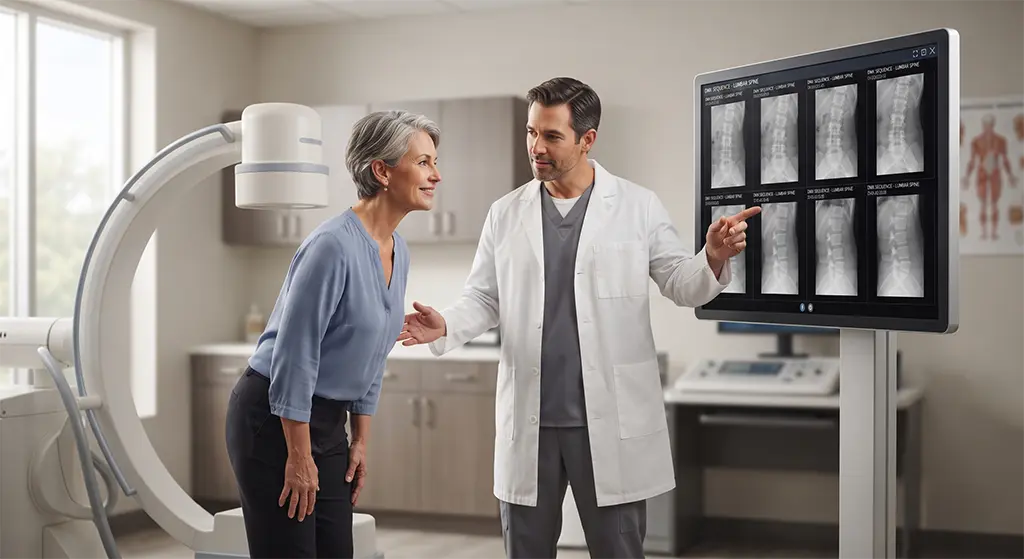
Digital Motion X-Ray is fluoroscopic video imaging performed during guided movement. In lumbar cases, DMX may evaluate:
- Translation: sliding between vertebrae
- Angulation: tilting between vertebrae
- Hinge behavior: one level moving excessively
- Sequencing: whether movement is smooth or irregular
- Asymmetry: differences between movement directions
DMX does not replace MRI, CT, orthopedic evaluation, or neurological evaluation. It complements them when symptoms are motion- or posture-triggered.
How DMX findings can change care
A motion-based care plan may include:
- lumbar stabilization
- hip hinge retraining
- glute endurance
- standing tolerance progression
- dishwashing posture modification
- hard-floor footwear strategy
- task pacing
- safer bending mechanics
The goal is not just to relieve pain during treatment. The goal is to improve daily-life tolerance.
Practical steps while awaiting evaluation
- Open the cabinet under the sink and place one foot inside to reduce lumbar strain
- Stand closer to the sink
- Avoid leaning forward for long periods
- Shift positions often
- Use supportive shoes on tile floors
- Break dishes into shorter sessions
- Avoid twisting from the low back
- Turn the feet and hips when loading the dishwasher
Safety note
Seek medical evaluation if low back pain includes progressive weakness, numbness, bowel/bladder changes, severe trauma, fever, unexplained weight loss, or inability to walk.
FAQs
Why does doing dishes hurt my low back?
Doing dishes often requires slight forward bending, reaching, standing still, and twisting, which can stress motion-sensitive lumbar segments.
Can standing at the sink reveal instability?
Yes. Sustained standing and forward lean can reveal lumbar endurance or instability problems.
What does DMX show?
DMX evaluates real-time lumbar translation, angulation, hinge behavior, asymmetry, and motion sequencing.
Does DMX replace MRI?
No. DMX complements MRI/CT/X-ray when symptoms are motion- or posture-triggered.
References
- AAOS OrthoInfo: Low back pain and mechanical triggers
- PubMed-indexed literature on lumbar instability and segmental biomechanics
Footer: DMX Miami serves patients in Miami, Fort Lauderdale, Miami-Dade, Broward, the Florida Keys, Florida, the USA, and visitors from Colombia, Chile, Argentina, Mexico, and the Caribbean.
Learn more: Treatment
Schedule your appointment today:Appointments
Call 305-275-7475 orbook your appointment online

Dr. Rodolfo Alfonso, D.C.
Dr. Mark N. Berry, D.C.
Sunset Chiropractic and Wellness
8585 Sunset Dr. STE 102
Miami, Florida 33143