
Looking up at high shelves, cabinets, signs, ceiling fans, or overhead storage can trigger neck pain, headaches, dizziness, eye pressure, shoulder-blade burning, or arm tingling when the cervical spine is motion-sensitive. Neck extension places different stress on the upper cervical spine, lower cervical spine, and cervicothoracic junction. Digital Motion X-Ray (DMX) evaluates cervical motion in real time and can help identify translation, angulation, asymmetry, hinge behavior, or instability patterns that static imaging may not show.
- Looking up is a cervical extension task that can reveal motion sensitivity.
- Symptoms with overhead visual tasks may involve cervical instability, not just tight muscles.
- DMX can help guide stabilization-focused care and safer daily movement strategies.
Last updated: April 14, 2026
Reviewed by: DMX Miami clinical team
Looking up should be easy. But for some patients, checking a high shelf, reaching into a cabinet, looking at a menu board, watching fireworks, or looking up at a ceiling fan triggers symptoms.
At DMX Miami, we see patients from Miami, Fort Lauderdale, Miami-Dade County, Broward County, and the Florida Keys, and patients from the USA, Colombia, Chile, Argentina, Mexico, and the Caribbean who report extension-triggered neck symptoms.
Patients often say:
- “Looking up gives me neck pain.”
- “I get dizzy when I tilt my head back.”
- “High shelves trigger headaches.”
- “My shoulder blade burns after looking overhead.”
- “I avoid looking up because my neck feels unstable.”
- “My MRI was mild, but extension brings on symptoms.”
This pattern matters because looking up is not just a posture. It is a motion test.
Why looking up stresses the neck
Looking up requires cervical extension. The motion must be shared across the upper cervical spine, lower cervical spine, and upper back.
If one area does not move well, another area may move too much.
Looking up can stress:
- upper cervical joints
- facet joints
- cervical ligaments
- suboccipital muscles
- lower neck segments
- cervicothoracic junction
- shoulder-blade stabilizers
If the cervical spine is unstable, extension can trigger protective guarding.
Why dizziness can appear with extension
Some patients feel dizzy, lightheaded, visually strained, or disoriented when looking up. This can have several possible causes and should be evaluated carefully.
When dizziness occurs with neck extension, providers may consider:
- cervical motion sensitivity
- vestibular involvement
- visual tracking issues
- upper cervical proprioception
- neurological causes
- vascular considerations
- post-whiplash dysfunction
DMX does not replace medical, vestibular, neurological, or vascular evaluation. It can complement them when cervical motion appears to be part of the symptom pattern.
The high-shelf problem
High shelves and cabinets often combine extension with reaching. That means the neck is tilted back while the arms are overhead.
This adds load through:
- shoulders
- upper traps
- neck extensors
- thoracic spine
- cervical stabilizers
Patients may flare while:
- reaching into kitchen cabinets
- changing light bulbs
- placing luggage overhead
- looking up at store shelves
- checking signs
- washing hair
- working overhead
When extension plus overhead activity triggers symptoms, cervical stability should be evaluated.
Why static imaging may not explain extension pain
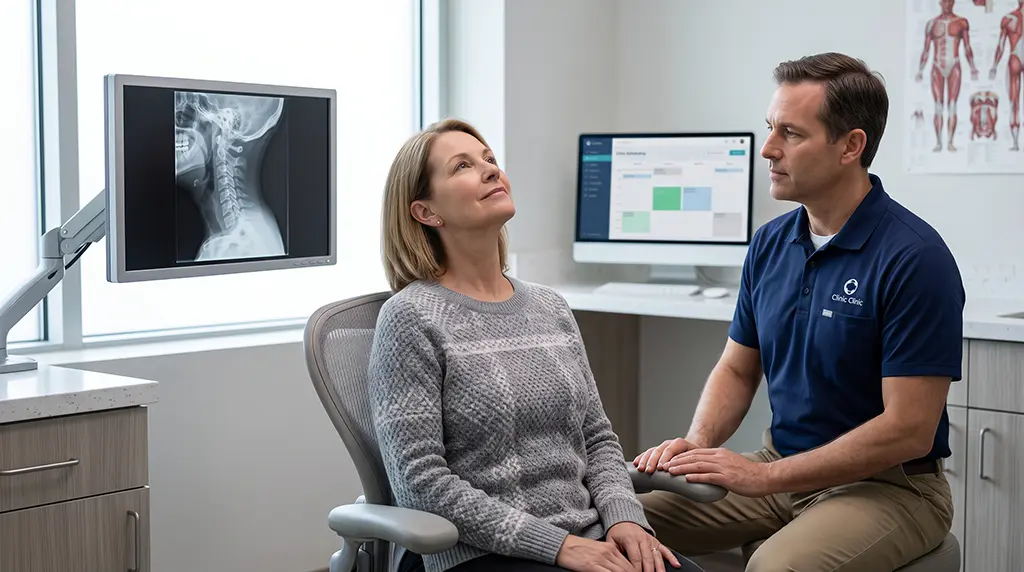
MRI, CT, and standard X-rays are usually static. They may not show what happens during extension, return from extension, or combined extension with rotation.
Static imaging may not show:
- abnormal translation during extension
- abnormal angulation
- hinge behavior
- upper cervical asymmetry
- instability during motion
- sequencing problems
- symptom-producing movement patterns
This is why motion-based imaging may be useful when symptoms are reproducible.
How Digital Motion X-Ray helps
Digital Motion X-Ray uses fluoroscopic video imaging during guided cervical movement. Providers may evaluate how the cervical segments move through flexion, extension, rotation, or other guided motions.
DMX may assess:
- Translation: abnormal sliding between vertebrae
- Angulation: abnormal tilting between vertebrae
- Asymmetry: left-right differences
- Hinge behavior: one segment moving too much
- Sequencing: whether motion is smooth or irregular
DMX does not replace MRI, CT, neurological evaluation, vestibular testing, or emergency evaluation. It complements them when symptoms are motion-triggered.
How DMX findings can change care
If abnormal motion is identified, care may include:
- cervical stabilization
- extension-control training
- upper cervical coordination
- posture endurance
- safer overhead reaching strategy
- manual therapy modifications
- graded return to overhead tasks
The goal is not to avoid looking up forever. The goal is to improve tolerance safely.
Practical steps while awaiting evaluation
- Avoid prolonged end-range extension
- Move closer to the shelf before looking up
- Use a step stool instead of forcing the neck back
- Turn the whole body instead of twisting the neck overhead
- Take breaks during overhead tasks
- Avoid combining dizziness-provoking extension with lifting
- Track whether symptoms are pain, dizziness, headache, or arm-related
Safety note
Seek urgent evaluation if looking up causes fainting, severe dizziness, neurological symptoms, sudden weakness, severe headache, vision changes, or symptoms after trauma.
FAQs
Why does looking up hurt my neck?
Looking up places the cervical spine into extension, which can stress motion-sensitive or unstable segments.
Can looking up cause dizziness?
It can in some patients, but dizziness with extension should be evaluated carefully to rule out non-cervical causes.
What does DMX show?
DMX evaluates real-time cervical translation, angulation, asymmetry, hinge behavior, and motion sequencing.
Does DMX replace MRI or vestibular testing?
No. DMX complements other evaluations when symptoms are motion-triggered.
References
- Cleveland Clinic: Neck pain, whiplash, and cervicogenic symptom education
- PubMed-indexed literature on cervical biomechanics, videofluoroscopy, and whiplash-associated disorders
Footer: DMX Miami serves patients in Miami, Fort Lauderdale, Miami-Dade, Broward, the Florida Keys, Florida, the USA, and visitors from Colombia, Chile, Argentina, Mexico, and the Caribbean.
Learn more: Treatment
Schedule your appointment today:Appointments
Call 305-275-7475 orbook your appointment online

Dr. Rodolfo Alfonso, D.C.
Dr. Mark N. Berry, D.C.
Sunset Chiropractic and Wellness
8585 Sunset Dr. STE 102
Miami, Florida 33143