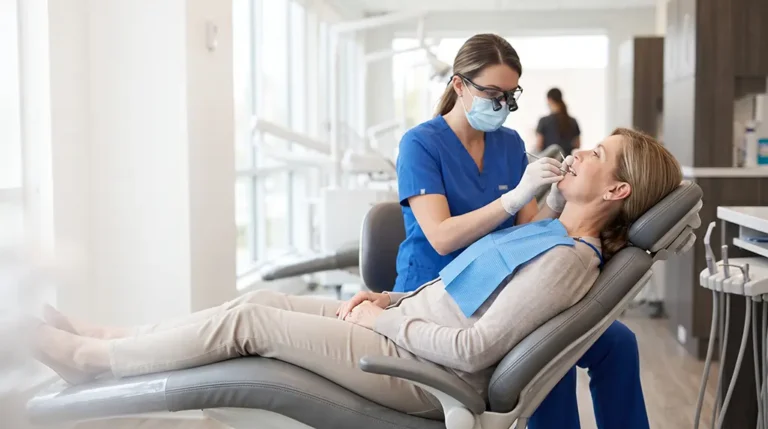
Dental cleanings and dental procedures can trigger neck pain, headaches, dizziness, jaw tension, ear pressure, or shoulder-blade burning because the neck may be held in extension or rotation while the jaw remains open for long periods. If symptoms flare after dental chair positioning, the issue may involve cervical instability or upper cervical motion sensitivity. Digital Motion X-Ray (DMX) evaluates cervical motion in real time and can help identify translation, angulation, asymmetry, hinge behavior, or instability patterns that static imaging may miss.
- Dental chair positioning can place the neck in sustained extension or rotation.
- Jaw opening and neck position can overlap in patients with whiplash or upper cervical instability.
- DMX can help evaluate real-time cervical motion when dental visits trigger symptoms.
Last updated: April 14, 2026
Reviewed by: DMX Miami clinical team
Dental cleanings are routine, but for some patients, the neck symptoms afterward are anything but routine. A dental chair places the patient in a reclined position, often with the neck extended or rotated while the mouth remains open.
At DMX Miami, we see patients from Miami, Fort Lauderdale, Miami-Dade County, Broward County, and the Florida Keys, as well as visitors from the USA, Colombia, Chile, Argentina, Mexico, and the Caribbean, who report neck symptoms after dental visits.
Patients often say:
- “My neck hurts after the dentist.”
- “The chair position gives me headaches.”
- “My jaw and upper neck flare together.”
- “I feel dizzy after dental cleanings.”
- “My ear pressure gets worse after dental work.”
- “I had whiplash, and dental visits always trigger me.”
This pattern matters because dental positioning combines neck posture, jaw opening, and time under load.
Why dental chairs stress the neck
During a dental visit, the neck may be held in:
- extension
- slight rotation
- side-bending
- unsupported posture
- prolonged stillness
- mouth-open jaw tension
- shoulder elevation
- upper cervical compression
For a stable neck, this may create mild stiffness. For a motion-sensitive neck, it can trigger a larger flare.
Why jaw opening matters
The jaw and neck work together. Holding the mouth open for long periods can increase tension through the jaw, throat, upper neck, and suboccipital region.
Patients may feel:
- jaw tightness
- ear pressure
- base-of-skull headache
- upper neck pain
- temple pressure
- dizziness
- shoulder-blade burning
This does not mean every dental flare is purely cervical. TMJ, dental, neurological, vestibular, and ENT factors may all need consideration. But when symptoms change with neck position, cervical motion should be evaluated.
Why prior whiplash increases sensitivity
After whiplash, the cervical spine may become more reactive to sustained extension, rotation, or awkward positioning. Dental chair posture can reproduce these stresses.
Patients with prior whiplash often report symptoms after:
- dental cleanings
- hair salon sinks
- looking up
- sleeping on planes
- recliner chairs
- overhead activities
- driving with poor headrest support
These are all situations where the neck may be held in a vulnerable position.
Why static imaging may not explain dental-related symptoms
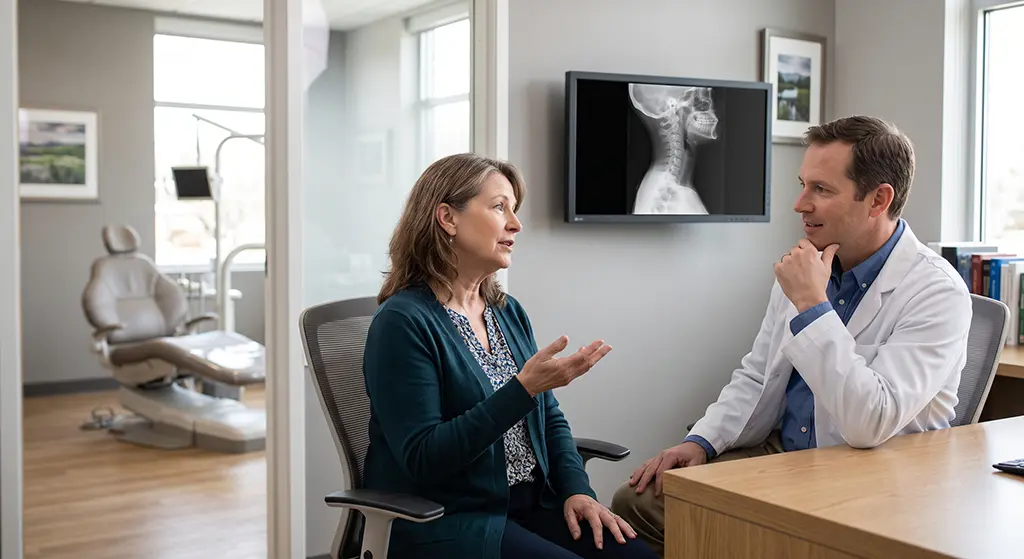
MRI, CT, and standard X-rays are useful, but dental-chair symptoms occur during sustained posture and jaw-neck interaction. Static imaging may not show what happens when the neck is held in extension or rotation for 30–90 minutes.
Static imaging may not show:
- abnormal cervical translation
- abnormal angulation
- upper cervical asymmetry
- hinge behavior
- instability during guided motion
- sequencing problems
- posture-triggered symptom patterns
This is why dynamic cervical evaluation may help.
How Digital Motion X-Ray helps
Digital Motion X-Ray uses fluoroscopic video imaging during guided cervical motion. It helps evaluate real-time cervical mechanics.
DMX may assess:
- Translation: abnormal sliding between vertebrae
- Angulation: abnormal tilting between vertebrae
- Asymmetry: left-right differences
- Hinge behavior: one segment moving too much
- Sequencing: whether motion is smooth or irregular
DMX does not replace dental evaluation, TMJ evaluation, MRI, CT, ENT, vestibular, or neurological care. It complements them when symptoms are motion- or posture-triggered.
How DMX findings can change care
If abnormal cervical motion is present, care may include:
- cervical stabilization
- upper cervical control
- jaw-neck coordination
- posture endurance training
- dental chair positioning strategies
- safer manual therapy selection
- coordination with dental or TMJ providers when appropriate
The goal is to reduce symptom flares from necessary dental care.
Practical steps before dental visits
- Tell the dental team you have neck sensitivity
- Ask for neck support if appropriate
- Request short breaks during longer procedures
- Avoid prolonged end-range extension when possible
- Keep shoulders relaxed
- Note whether symptoms are neck, jaw, ear, headache, or dizziness dominant
- Schedule evaluation if symptoms repeatedly flare after dental visits
Safety note
Seek medical evaluation if symptoms include severe headache, fainting, neurological changes, facial weakness, jaw locking, sudden hearing changes, severe dizziness, or progressive arm weakness.
FAQs
Why does my neck hurt after the dentist?
Dental chair positioning can hold the neck in extension or rotation while the jaw remains open, stressing motion-sensitive cervical segments.
Can dental work trigger headaches after whiplash?
Yes. Sustained neck extension and jaw tension may flare cervicogenic headache patterns in some patients.
What does DMX show?
DMX evaluates real-time cervical translation, angulation, asymmetry, hinge behavior, and motion sequencing.
Does DMX replace dental or TMJ evaluation?
No. DMX complements dental, TMJ, ENT, neurological, and imaging evaluations when cervical motion appears involved.
References
- Cleveland Clinic: Neck pain, whiplash, and cervicogenic headache education
- PubMed-indexed literature on cervical biomechanics, videofluoroscopy, and whiplash-associated disorders
Footer: DMX Miami serves patients in Miami, Fort Lauderdale, Miami-Dade, Broward, the Florida Keys, Florida, the USA, and visitors from Colombia, Chile, Argentina, Mexico, and the Caribbean.
Learn more: Treatment
Schedule your appointment today:Appointments
Call 305-275-7475 orbook your appointment online

Dr. Rodolfo Alfonso, D.C.
Dr. Mark N. Berry, D.C.
Sunset Chiropractic and Wellness
8585 Sunset Dr. STE 102
Miami, Florida 33143