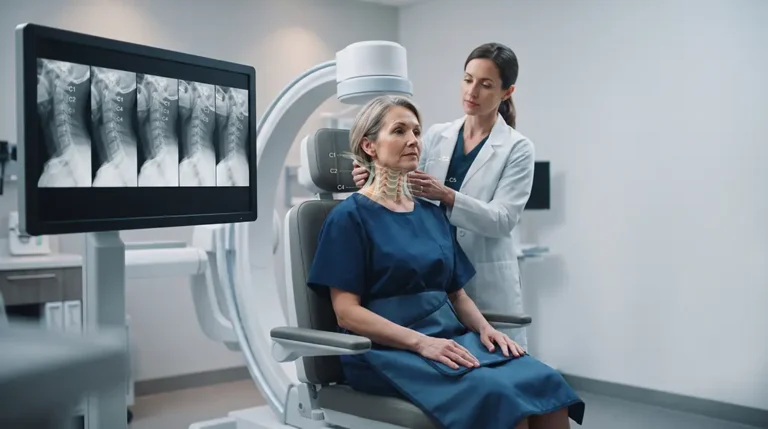
Whiplash can stress multiple structures in the cervical spine, including muscles, joints, nerves, and ligaments. MRI and CT provide important structural information, but some patients continue to experience pain, headaches, dizziness, clicking, or movement-related symptoms even when static imaging does not clearly explain them. Digital Motion X-Ray (DMX) uses fluoroscopic video imaging to evaluate how cervical vertebrae move during controlled motion. DMX does not directly photograph a ligament tear. Instead, it can provide information about vertebral translation, angulation, asymmetry, and other motion patterns that may be considered alongside the history, examination, and other imaging when cervical instability is suspected.
- Cervical ligaments help control excessive motion between vertebrae.
- Whiplash can involve ligamentous as well as muscular and joint injury.
- DMX evaluates vertebral movement; it should not be described as directly “seeing” a ligament tear.
- Translation and angulation findings must be interpreted within the full clinical picture.
- DMX can complement MRI, CT, standard X-rays, physical examination, and neurological evaluation.
Last updated: September 22, 2026
Reviewed by: DMX Miami clinical team
One of the most common questions we receive at DMX Miami is:
“Can Digital Motion X-Ray actually show a ligament injury?”
The answer requires an important distinction.
DMX does not directly visualize a cervical ligament the same way an MRI may visualize certain soft tissues.
Instead, Digital Motion X-Ray evaluates what happens to the vertebrae during movement.
That distinction is critical.
Ligaments help control spinal motion. If a ligamentous support system has been compromised, one possible consequence may be abnormal motion between vertebral segments.
Therefore, the clinical question is not simply:
“Can we see the ligament?”
It may also be:
“Is the spinal segment moving normally?”
What Cervical Ligaments Do

The cervical spine has multiple ligaments and supporting structures that help:
- guide normal movement
- limit excessive movement
- stabilize adjacent vertebrae
- coordinate flexion and extension
- control rotation
- control side-bending
These structures work together with muscles, joints, discs, and the nervous system.
The neck is designed to move.
The goal is not to eliminate motion.
The goal is controlled motion.
What Happens During Whiplash?
Whiplash occurs when rapid forces move the head and neck beyond their normal tolerance.
Motor vehicle collisions are a common cause, but similar acceleration-deceleration mechanisms can occur during:
- falls
- sports injuries
- sudden jolts
- recreational accidents
- certain amusement rides
- other trauma
Whiplash-associated symptoms may include:
- neck pain
- stiffness
- headache
- shoulder or shoulder-blade pain
- tingling
- numbness
- dizziness
- visual symptoms
Some symptoms appear immediately, while others may develop later.
Why Ligament Injury Can Be Difficult to Evaluate
Different diagnostic tests answer different questions.
MRI
MRI provides detailed static imaging of:
- spinal cord
- discs
- neural structures
- soft tissues
- many structural abnormalities
CT
CT provides excellent visualization of bone and is particularly important in many acute-trauma situations.
Standard X-Ray
Standard radiography provides useful information regarding:
- alignment
- bone structure
- degenerative changes
- posture
- certain traumatic findings
DMX
DMX evaluates motion.
That means the cervical vertebrae can be observed during controlled movement rather than only in one resting position.
What DMX Can Evaluate
Dynamic assessment may include:
Translation
Translation is sliding movement between adjacent vertebrae.
Angulation
Angulation describes the changing angle between segments.
Asymmetry
Movement toward one side may differ from movement toward the other.
Hinge Behavior
One segment may appear to contribute disproportionately to motion while neighboring segments move less.
Motion Sequencing
The order in which vertebral segments contribute to a movement may also be clinically informative.
These findings do not automatically prove that a particular ligament is torn.
They are pieces of a larger diagnostic puzzle.
Why Motion Matters
Consider a patient who says:
- “I feel fine if I don’t move.”
- “Turning left makes my neck catch.”
- “Looking up triggers dizziness.”
- “My neck clicks and hurts when I rotate.”
- “My MRI was mild, but I cannot tolerate driving.”
- “I feel like my head gets heavier throughout the day.”
Those complaints occur during function.
If the symptoms are consistently movement-dependent, evaluating movement can be clinically useful.
The Difference Between Ligament Damage and Instability
These terms should not automatically be treated as identical.
A ligament can be injured without necessarily producing clinically significant instability.
Conversely, abnormal movement may have more than one contributing factor.
That is why DMX findings should be correlated with:
- accident mechanism
- symptoms
- physical examination
- neurological findings
- prior imaging
- functional limitations
- other appropriate testing
No responsible evaluation should rely on one imaging result alone.
Why This Matters in Personal-Injury Cases
After a motor vehicle collision, patients may have persistent symptoms despite relatively mild static imaging.
Objective evaluation of movement can sometimes provide additional clinical information regarding how the cervical spine functions.
This can help providers:
- better understand symptom triggers
- choose safer treatment approaches
- design stabilization programs
- document functional abnormalities
- coordinate care with other healthcare professionals
The purpose of imaging should remain clinical.
Documentation follows from good clinical evaluation—not the other way around.
How Findings Can Influence Treatment
If clinically significant abnormal motion is identified, care may place greater emphasis on:
- cervical stabilization
- deep neck muscle endurance
- upper cervical control
- gradual motion retraining
- activity modification
- avoiding excessive provocative end-range stress
- carefully selected manual techniques
- ergonomic modifications
The treatment strategy becomes less about simply “loosening a tight neck” and more about understanding why the neck is protecting itself.
DMX Is Not a Replacement for Other Imaging
DMX should not replace appropriate:
- MRI
- CT
- emergency evaluation
- neurological examination
- vascular assessment
- vestibular testing
- orthopedic consultation
Different tests answer different questions.
In many cases, the most useful approach combines information.
When to Consider Further Evaluation
Persistent symptoms after trauma deserve evaluation when they include:
- movement-triggered neck pain
- painful clicking or catching
- recurrent headaches
- dizziness associated with neck movement
- shoulder-blade burning
- arm tingling
- heavy-head fatigue
- difficulty driving
- symptoms repeatedly triggered by ordinary motion
Safety Note
Seek urgent medical attention for severe or rapidly worsening headache, progressive weakness, significant new numbness, fainting, confusion, severe visual changes, loss of coordination, difficulty walking, or other major neurological symptoms after trauma.
FAQs
Can DMX directly see a torn cervical ligament?
Not in the same way MRI may visualize certain soft tissues. DMX evaluates vertebral movement that may provide information about spinal stability.
Can whiplash injure cervical ligaments?
Whiplash can affect multiple cervical structures, including ligaments, muscles, joints, and nerves.
Does abnormal movement automatically mean a ligament is torn?
No. Motion findings need to be interpreted with the patient’s history, examination, symptoms, and other imaging.
Why use DMX if I already had an MRI?
MRI primarily provides static anatomical information. DMX evaluates cervical movement and may answer a different clinical question.
References
- Cleveland Clinic: Whiplash
- PubMed-indexed literature on cervical videofluoroscopy and dynamic imaging
- Published literature on whiplash-associated disorders and cervical instability
Footer: DMX Miami serves patients in Miami, Fort Lauderdale, Miami-Dade, Broward, the Florida Keys, Florida, the USA, and visitors from Colombia, Chile, Argentina, Mexico, and the Caribbean.
Learn more: Treatment
Schedule your appointment today:Appointments
Call 305-275-7475 orbook your appointment online

Dr. Rodolfo Alfonso, D.C.
Dr. Mark N. Berry, D.C.
Sunset Chiropractic and Wellness
8585 Sunset Dr. STE 102
Miami, Florida 33143