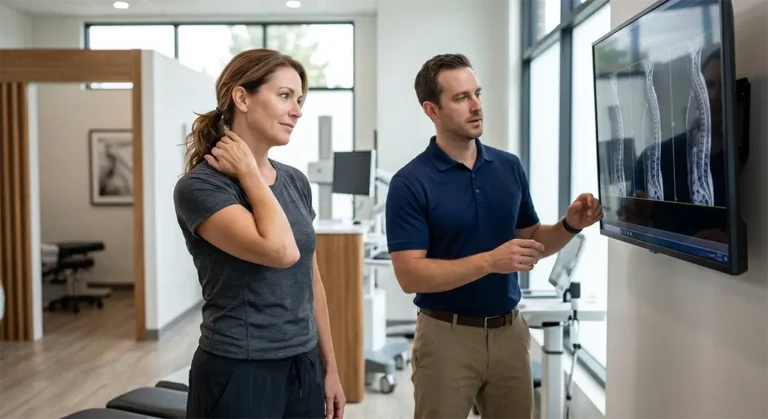
After a slip-and-fall injury, standard X-rays may rule out fracture but still fail to explain persistent neck or back pain. If symptoms are triggered by motion turning, bending, looking up, standing, or walking ligament injury, instability, or hinge patterns may be involved. Digital Motion X-Ray (DMX) evaluates spinal motion in real time and can help document translation, angulation, asymmetry, and abnormal motion behavior that static imaging may miss.
- Negative X-rays do not rule out motion-based ligament or instability problems.
- Slip-and-fall injuries often involve twisting, bracing, and sudden uncontrolled motion.
- DMX can help guide stabilization-focused care when symptoms remain motion-triggered.
Last updated: April 14, 2026
Reviewed by: DMX Miami clinical team
Slip-and-fall injuries happen quickly. Wet tile, pool decks, grocery store floors, hotel lobbies, stairs, sidewalks, docks, and boat ramps are common in Miami, Fort Lauderdale, Miami-Dade County, Broward County, and the Florida Keys. We also see visitors from the USA, Colombia, Chile, Argentina, Mexico, and the Caribbean who are injured while traveling in South Florida.
Many patients are told, “The X-rays are negative,” which is important because fractures may be ruled out. But the patient may still have:
- Neck pain
- Low back pain
- Headaches
- Dizziness
- Shoulder-blade burning
- Hip/buttock pain
- Pain with bending or turning
- Catching or locking sensations
- Symptoms that worsen over days
A negative X-ray does not always mean the spine is moving normally.
Why slip-and-fall injuries are different
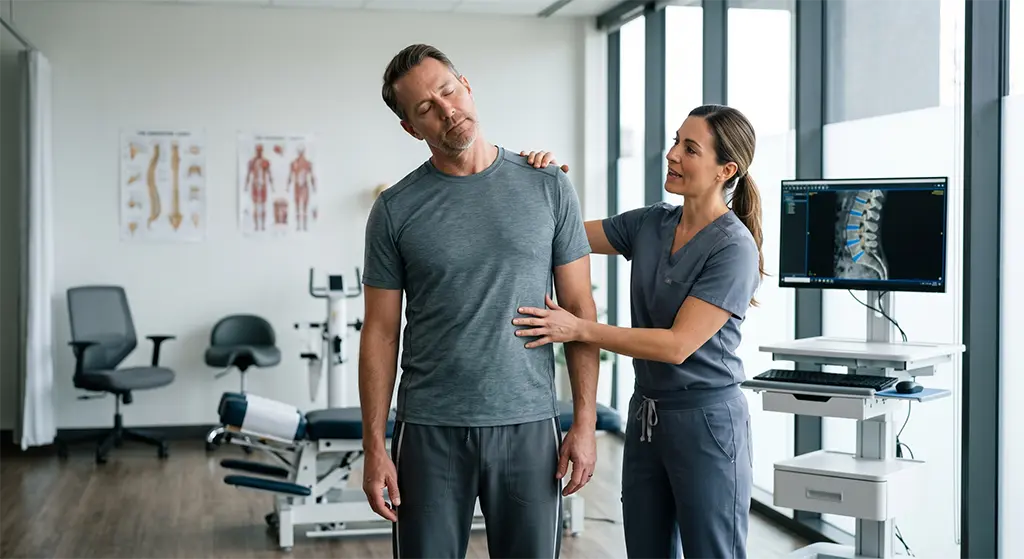
A fall is unpredictable. The body often twists, braces, reaches, or lands awkwardly. That sudden movement can stress ligaments, joints, muscles, discs, and stabilizing systems.
Unlike a controlled gym movement, a fall happens too fast for the body to prepare.
Why symptoms may persist after negative X-rays
Standard X-rays are helpful for evaluating bone alignment, fractures, and certain structural concerns. But they are static. They do not fully show how the spine behaves during motion.
Persistent symptoms may come from:
- Ligament strain
- Segmental instability
- Muscle guarding
- Joint irritation
- Hinge behavior
- Motion asymmetry
- Compensation between regions
If symptoms are motion-triggered, the missing question is: What happens when the spine moves?
Common motion triggers after a fall
Patients may report:
- Neck pain when turning
- Headache when looking up or down
- Low back pain when bending
- Pain when standing from a chair
- Sharp catch rolling in bed
- Dizziness in busy environments
- Pain descending stairs
- Symptoms worse after driving
These are functional clues. They help providers decide whether motion-based imaging is appropriate.
How DMX evaluates the spine after a fall
Digital Motion X-Ray is fluoroscopic video imaging performed during guided movement. It can help evaluate:
- Translation: sliding between vertebrae
- Angulation: tilting between vertebrae
- Asymmetry: motion differences between directions
- Hinge behavior: one level moving too much
- Sequencing: whether motion is smooth or irregular
DMX does not replace MRI, CT, or standard X-rays. It complements them when the concern is ligament injury, instability, or abnormal motion behavior.
Neck vs low back after a slip-and-fall
Cervical symptoms
Falls can create rapid head/neck motion, even without a direct head impact. Cervical symptoms may include neck pain, headaches, dizziness, visual strain, or arm symptoms.
Lumbar symptoms
Falls can create twisting and compression through the low back. Lumbar symptoms may include low back pain, buttock pain, catching, stiffness, and pain during transitions.
Both regions may need evaluation depending on the mechanism and symptoms.
How DMX findings can change care
Stabilization-focused rehab
If instability is present, rehab may focus on controlled stabilization before aggressive mobility.
Safer activity rules
Patients may need temporary limits around bending, twisting, lifting, stair descent, or prolonged sitting.
Better manual care choices
If specific segments show abnormal motion, providers can avoid overstressing them.
Clearer documentation
Objective motion findings can help explain why a patient remains limited despite negative static imaging.
What patients should track after a fall
Track:
- Date and mechanism of fall
- Direction of fall: backward, forward, side, twist
- Body parts impacted
- Delayed symptoms
- Motion triggers
- Driving and sleep tolerance
- Headache/dizziness patterns
- What improves or worsens symptoms
This helps match imaging findings to real-life limitations.
Safety note
Seek urgent evaluation after a fall if you have head injury symptoms, loss of consciousness, severe headache, neurological changes, severe pain, inability to bear weight, bowel/bladder changes, fever, or progressive weakness.
FAQs
Can I still have a spinal injury if X-rays are negative?
Yes. X-rays may rule out fracture but may not show ligament injury, instability, or motion-based dysfunction.
What does DMX show after a slip-and-fall?
DMX evaluates real-time spinal translation, angulation, asymmetry, and hinge behavior during guided motion.
Does DMX replace MRI or CT?
No. DMX complements other imaging when motion and stability are the clinical questions.
When should I consider DMX after a fall?
When symptoms persist and are reproducible with motion despite negative or mild static imaging.
References
- AAOS OrthoInfo: Neck and low back pain education
- PubMed-indexed literature on dynamic fluoroscopy and spinal instability assess
Learn more: Treatment
Schedule your appointment today:Appointments
Call 305-275-7475 orbook your appointment online

Dr. Rodolfo Alfonso, D.C.
Dr. Mark N. Berry, D.C.
Sunset Chiropractic and Wellness
8585 Sunset Dr. STE 102
Miami, Florida 33143