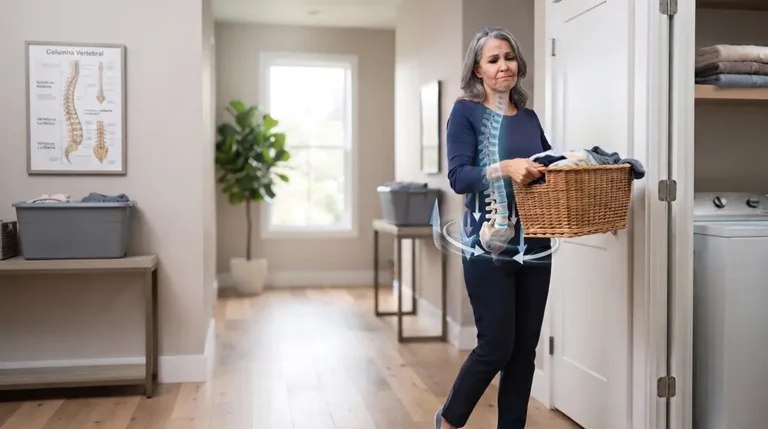
Laundry baskets, storage bins, pet-food bags, boxes, and household loads challenge the low back in ways that ordinary walking does not. The load is often held in front of the body, blocks the view of the feet, encourages the patient to lean backward, and may be carried while twisting through doorways or climbing stairs. If the low back catches, shifts, or flares during these tasks, poor load sharing or lumbar segmental instability may be part of the problem.
- Carrying objects in front changes the body’s center of gravity.
- Twisting while carrying a load increases lumbar demand.
- Stairs, doorways, and setting the object down can be more provocative than the actual lift.
- DMX can evaluate lumbar movement patterns when everyday loaded activities repeatedly trigger pain.
Last updated: September 15, 2026
Reviewed by: DMX Miami clinical team
Sometimes the hardest part of laundry is not lifting the basket.
It is carrying it.
Patients often tell us:
- “I can pick the basket up, but walking with it hurts.”
- “My back catches when I turn through the doorway.”
- “Going down the stairs with laundry hurts.”
- “Setting the basket down is worse than picking it up.”
- “I twisted with a storage bin and my back locked.”
- “My back flares every time I carry things around the house.”
These patterns can reveal how the lumbar spine behaves under real-world load.
Carrying Changes Your Center of Gravity
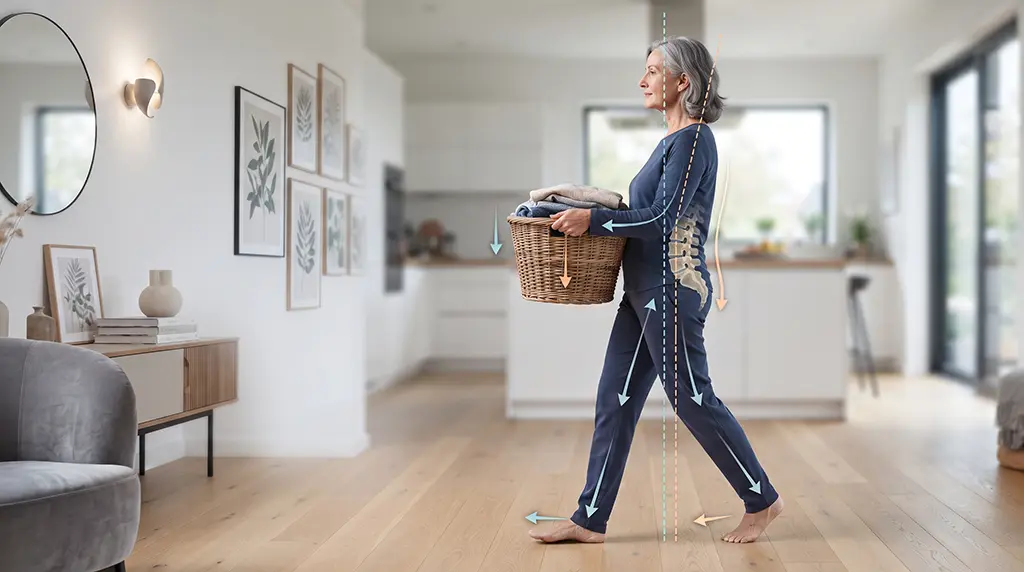
Without a load, the body can balance weight efficiently.
Hold a large basket in front of you and everything changes.
The body may compensate by:
- leaning backward
- increasing lumbar extension
- widening the stance
- shortening steps
- bracing harder
- shifting weight side to side
If the load is heavy or bulky, the lumbar stabilizers work even harder.
Why Bulky Objects Can Be Harder Than Heavy Objects
A relatively light laundry basket can sometimes be more awkward than a compact heavier object.
Why?
Because it is held farther from the body.
As the load moves farther forward, the mechanical demand on the trunk increases.
Large objects may also block your ability to:
- see the floor
- move the arms freely
- use a handrail
- rotate normally
That creates additional compensation.
The Doorway Twist
A common trigger happens when a patient approaches a narrow doorway.
Instead of repositioning the feet, the patient:
- Carries the basket forward.
- Rotates the shoulders.
- Twists the low back.
- Keeps the feet relatively fixed.
- Moves the load through the doorway.
That creates loaded rotation.
For a motion-sensitive lumbar segment, that may be the exact moment the back catches.
Setting the Basket Down
Many patients focus on lifting technique and forget that lowering can be just as demanding.
Setting a basket down may combine:
- flexion
- reaching
- rotation
- deceleration
- shifting weight
The body has to control the load all the way down.
If the patient simply drops into spinal flexion, symptoms may appear.
Stairs Make the Task More Complex
Carrying laundry on stairs adds:
- single-leg loading
- balance demands
- pelvic control
- changing step height
- reduced ability to use handrails
If back pain or leg weakness makes stairs unsafe, reduce the load or get help.
Why Static Imaging May Not Explain the Problem
The symptom occurs while the spine is:
- loaded
- moving
- rotating
- transitioning
A static MRI or X-ray may provide valuable structural information without recreating that functional condition.
Dynamic imaging may provide complementary information about segmental motion.
How Digital Motion X-Ray Helps
DMX uses fluoroscopic imaging during guided spinal movement.
A lumbar assessment may evaluate:
- translation
- angulation
- movement asymmetry
- hinge behavior
- movement sequencing
Clinical significance depends on the entire patient evaluation.
DMX does not replace MRI, CT, neurological evaluation, orthopedic care, or physical examination.
What a Better Rehabilitation Plan May Include
If the problem involves movement control, rehabilitation may focus on:
- hip hinge mechanics
- abdominal bracing
- glute strength
- rotational control
- loaded walking
- carrying mechanics
- stair control
- lifting and lowering technique
The objective is not merely to become stronger.
The patient needs to control the spine while moving with a load.
Practical Strategies
- Divide laundry into smaller loads.
- Hold loads close to the body.
- Turn with your feet instead of twisting.
- Avoid carrying bulky objects on stairs during an active flare.
- Keep one hand available for a rail when necessary.
- Set loads onto an elevated surface when possible.
- Avoid bending and twisting simultaneously.
- Use a rolling cart when appropriate.
When to Seek Evaluation
Persistent pain deserves attention if:
- the back repeatedly catches while carrying
- the same side always hurts
- symptoms travel into a leg
- weakness develops
- carrying capacity is decreasing
- household tasks are becoming difficult
Safety Note
Seek prompt medical evaluation for progressive weakness, major numbness, bowel or bladder changes, saddle numbness, fever, significant trauma, or severe rapidly worsening back pain.
FAQs
Why does carrying a laundry basket hurt my back?
Carrying a basket shifts the center of gravity and increases the stabilization demand on the lumbar spine.
Why does twisting with the basket cause pain?
Loaded rotation places additional stress on the spinal joints, muscles, and stabilizing structures.
Can DMX evaluate lumbar instability?
Dynamic radiographic imaging can be used to assess segmental movement, including translation and angulation, in appropriate clinical situations.
Should I avoid carrying things?
Usually the long-term goal is to improve safe load tolerance rather than permanently avoiding normal activity.
References
- PubMed-indexed literature on lumbar segmental instability
- Published research on dynamic lumbar radiography
- Orthopedic literature on mechanical low-back pain and load management
Footer: DMX Miami serves patients in Miami, Fort Lauderdale, Miami-Dade, Broward, the Florida Keys, Florida, the USA, and visitors from Colombia, Chile, Argentina, Mexico, and the Caribbean.
Learn more: Treatment
Schedule your appointment today:Appointments
Call 305-275-7475 orbook your appointment online

Dr. Rodolfo Alfonso, D.C.
Dr. Mark N. Berry, D.C.
Sunset Chiropractic and Wellness
8585 Sunset Dr. STE 102
Miami, Florida 33143