
Pushing a shopping cart, stroller, wheelchair, heavy door, or other rolling load changes how the trunk and pelvis manage force. People often lean forward, extend the arms, stiffen the low back, and take shorter steps. Turning a loaded cart adds rotation. If pushing repeatedly produces low-back pain, catching, buttock symptoms, or stiffness, the problem may involve endurance, hip-spine coordination, or lumbar movement control. Digital Motion X-Ray can add information about segmental motion in appropriately selected patients.
- Pushing creates a different mechanical demand than ordinary walking.
- A heavy or poorly rolling cart increases force requirements.
- Turning a cart introduces rotational demand.
- Leaning heavily on a cart may temporarily reduce symptoms while altering normal walking mechanics.
- Lumbar instability is multifactorial and should be evaluated with symptoms, examination, and imaging rather than any single finding.
Last updated: September 22, 2026
Reviewed by: DMX Miami clinical team
A shopping cart seems like support.
Sometimes it is.
But pushing a cart also changes how the body moves.
Patients may tell us:
- “My back starts hurting halfway through the store.”
- “Pushing the cart uphill hurts.”
- “Turning the cart makes my back catch.”
- “A heavy cart bothers me much more.”
- “I lean on the cart because it makes my back feel better.”
- “I can walk normally, but pushing something hurts.”
These details matter.
Pushing Is Not the Same as Walking
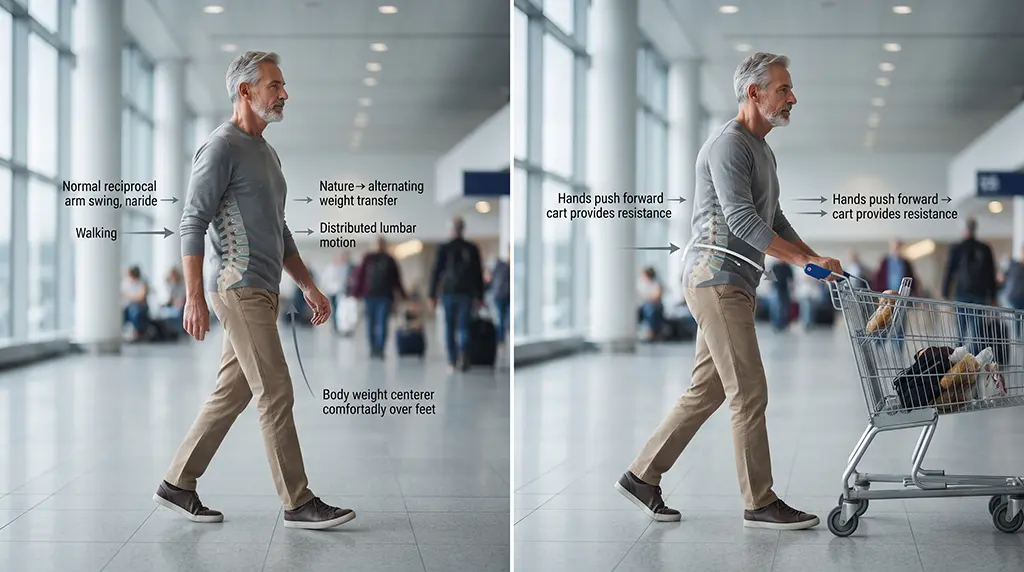
During ordinary walking, the arms swing and the trunk rotates naturally.
When pushing a cart:
- the hands remain fixed
- the arms stay forward
- natural arm swing decreases
- the trunk may lean forward
- step length may shorten
- the abdominal and spinal muscles manage additional force
The movement strategy changes.
Cart Weight Matters
An empty cart may create almost no symptoms.
A cart loaded with:
- bottled water
- groceries
- pet food
- household supplies
can feel completely different.
Now the patient must generate additional forward force.
A wheel that sticks or pulls sideways can increase the demand further.
Turning May Be the Trigger
Straight-line pushing may be tolerable.
The problem appears when turning the aisle.
To turn a loaded cart, the patient may:
- Keep the hands fixed.
- Rotate the shoulders.
- Shift the pelvis.
- Twist through the lumbar spine.
- Push through the turn.
That introduces loaded rotation.
If lumbar movement control is impaired, the turn can trigger a sharp catch.
Why Strollers Can Be Similar
Parents and grandparents may experience the same problem with a stroller.
Additional factors include:
- hills
- curbs
- uneven sidewalks
- stopping and starting
- steering with one hand
- carrying bags on the stroller
Walking uphill while pushing can substantially increase the demand.
Why Some Patients Lean Heavily on the Cart
A patient may discover:
“My back actually feels better if I lean over the cart.”
That can happen for several reasons and does not automatically indicate instability.
For example, certain lumbar conditions may change symptoms depending on flexion or extension posture.
This symptom pattern should be reported to the examining clinician because it may help differentiate possible causes.
The Difference Between Fatigue and Instability
Back fatigue after pushing a heavy cart does not automatically mean the spine is unstable.
Possible causes include:
- muscular endurance
- poor conditioning
- hip weakness
- arthritis
- disc-related pain
- spinal stenosis
- lumbar movement dysfunction
- other mechanical causes
Lumbar instability is a multifactorial diagnosis.
This is why history and examination matter.
How Digital Motion X-Ray May Help
When lumbar instability is clinically suspected, dynamic imaging may add information regarding:
- translation
- angulation
- movement asymmetry
- hinge behavior
- segmental motion
These findings should be combined with:
- symptoms
- physical examination
- functional limitations
- other imaging
No single test should determine the diagnosis by itself.
How Findings May Change Rehabilitation
If movement control is part of the problem, rehabilitation may include:
- trunk stabilization
- hip and glute strengthening
- pushing mechanics
- rotational control
- walking endurance
- load progression
- posture variability
The objective is not simply to make a patient avoid shopping or pushing a stroller.
It is to restore the ability to perform normal activities.
Practical Strategies
- Stand reasonably close to the cart.
- Avoid excessive forward reaching.
- Use both hands when possible.
- Turn with the feet and hips rather than twisting only the low back.
- Avoid overloading the cart during an active flare.
- Choose a cart with smoothly rolling wheels.
- Take shorter trips if endurance is limited.
- Do not use the cart as your only balance support if balance problems are developing.
When to Seek Evaluation
Consider evaluation if:
- pushing consistently reproduces pain
- turning a cart creates a sharp catch
- walking tolerance is declining
- leg symptoms develop
- one leg feels weaker
- you increasingly need the cart for support
- symptoms are interfering with normal errands
Safety Note
Seek urgent medical evaluation for progressive leg weakness, bowel or bladder dysfunction, saddle numbness, severe trauma, fever with significant back pain, or rapidly worsening neurological symptoms.
FAQs
Why does pushing a shopping cart hurt my back?
Pushing changes posture, arm swing, trunk mechanics, and force demands compared with ordinary walking.
Why does turning the cart hurt more?
Turning can add loaded trunk rotation and asymmetrical force.
Does leaning on a shopping cart mean my spine is unstable?
No. Several spinal conditions can change with posture. The symptom needs clinical evaluation.
Can DMX diagnose lumbar instability by itself?
No. Dynamic imaging may provide useful motion information, but current evidence supports combining imaging with clinical findings and patient symptoms.
References
- 2026 systematic review of lumbar spine instability diagnostic criteria
- PubMed-indexed literature on dynamic lumbar imaging
- Orthopedic literature on lumbar biomechanics and mechanical low-back pain
Footer: DMX Miami serves patients in Miami, Fort Lauderdale, Miami-Dade, Broward, the Florida Keys, Florida, the USA, and visitors from Colombia, Chile, Argentina, Mexico, and the Caribbean.
Learn more: Treatment
Schedule your appointment today:Appointments
Call 305-275-7475 orbook your appointment online

Dr. Rodolfo Alfonso, D.C.
Dr. Mark N. Berry, D.C.
Sunset Chiropractic and Wellness
8585 Sunset Dr. STE 102
Miami, Florida 33143