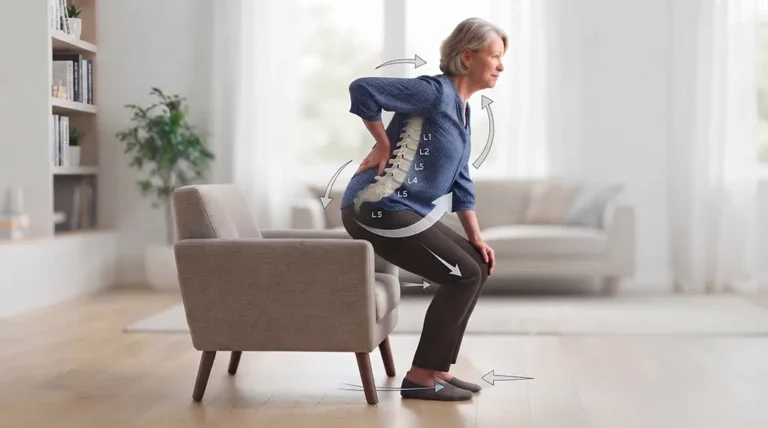
Standing from a low chair, couch, toilet, or bench requires more than leg strength. The hips must flex and extend, the pelvis must move forward over the feet, the trunk must control forward momentum, and the lumbar spine must remain stable while load rapidly changes. If the low back repeatedly catches, shifts, spasms, or hurts during sit-to-stand transitions, a movement-control problem may be involved. Dynamic spinal imaging can provide additional information about lumbar segmental motion in appropriately selected patients.
- Lower seats require greater hip, knee, and trunk demand.
- Pain often occurs during the transition rather than while sitting or standing.
- Using the hands to push up may hide underlying strength or control deficits.
- Lumbar instability is multifactorial and should not be diagnosed from a single symptom or test.
- DMX can provide motion information that is interpreted together with examination and other imaging.
Last updated: September 22, 2026
Reviewed by: DMX Miami clinical team
Some patients can walk for thirty minutes with relatively little difficulty.
Then they sit on a low couch.
Getting back up becomes the hardest movement of the day.
Patients often describe:
- “My back catches as I stand.”
- “I have to push off with my hands.”
- “The first step hurts.”
- “Low toilets are much worse.”
- “Soft couches make me feel stuck.”
- “I straighten halfway and my back grabs.”
This is not unusual.
A low seat changes the mechanics of standing.
What Happens During Sit-to-Stand?
To stand efficiently, the body must:
- Place the feet in a useful position.
- Lean the trunk forward.
- Shift the center of gravity over the feet.
- Generate force through the legs and hips.
- Stabilize the lumbar spine.
- Extend into upright posture.
All of this happens quickly.
If the hips, knees, trunk, or spine are not functioning efficiently, compensation occurs.
Why Seat Height Matters
A higher chair requires less movement.
A lower chair requires:
- greater hip flexion
- greater knee flexion
- more forward trunk movement
- more muscular force
- more balance control
That is why a standard office chair may feel fine while a low couch creates immediate difficulty.
Why Toilets Can Be a Common Trigger
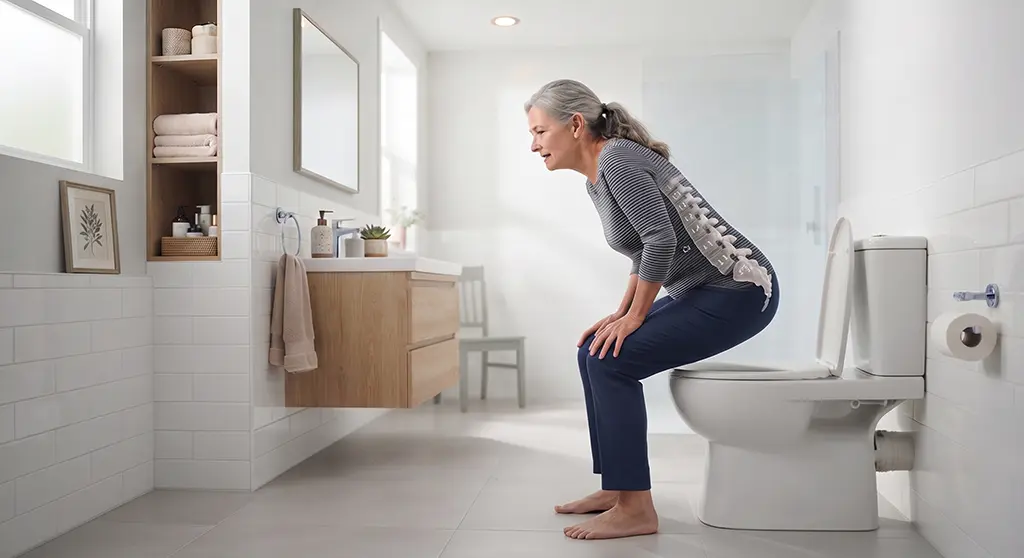
Toilets are particularly important because:
- the seat may be low
- the bathroom may be tight
- the patient may rotate while standing
- there may be little room for foot repositioning
- the movement is performed several times every day
Some patients begin using:
- counters
- sinks
- towel racks
to pull themselves upward.
That can create additional safety risks.
The Soft-Couch Problem
A soft couch may be even more difficult than a firm low chair.
The pelvis sinks backward.
The feet may end up farther forward.
The body then has to generate more momentum to stand.
The patient may:
- rock several times
- twist
- push with one arm
- hold the breath
- suddenly straighten
If the lumbar spine is motion-sensitive, the transition may reproduce symptoms.
The “Catch” During Straightening
A patient may stand halfway and suddenly feel a sharp catch.
Possible contributors can include:
- lumbar joint irritation
- muscle guarding
- hip restriction
- disc-related pain
- segmental motion dysfunction
- several other mechanical conditions
The symptom alone cannot diagnose instability.
But repeatable transition pain is clinically useful information.
Why Lumbar Instability Requires a Broader Evaluation
Current evidence supports a multimodal approach.
Lumbar instability is not appropriately diagnosed from:
- one symptom
- one orthopedic test
- one radiographic number
The most useful evaluation considers:
- patient symptoms
- functional limitations
- physical examination
- imaging when appropriate
This distinction is important.
DMX should add information not replace clinical reasoning.
How Digital Motion X-Ray May Help
Dynamic radiographic assessment can provide information regarding:
- vertebral translation
- segmental angulation
- asymmetry
- motion sequencing
- hinge behavior
These findings are interpreted alongside the patient’s symptoms and other clinical data.
Rehabilitation Should Address the Transition
If sit-to-stand is the problem, rehabilitation should eventually train sit-to-stand.
That may include:
- glute strengthening
- quadriceps strength
- trunk stabilization
- hip mobility
- hip-hinge mechanics
- controlled forward weight shift
- progressive lower-seat training
A treatment plan that only reduces pain while the patient is lying on a table may not solve the functional problem.
Practical Strategies
While symptomatic:
- move toward the front of the chair
- bring the feet underneath the body
- lean forward from the hips
- push through the legs
- use stable armrests when necessary
- avoid twisting during the rise
- choose firmer seating during severe flares
- avoid pulling on unstable towel racks or furniture
When to Seek Evaluation
Consider further evaluation if:
- sit-to-stand repeatedly causes a sharp catch
- one leg feels weaker
- symptoms travel down the leg
- you need your arms more and more
- low seats are becoming progressively difficult
- the first several steps are painful
- function is declining
Safety Note
Seek urgent medical attention for progressive leg weakness, bowel or bladder dysfunction, saddle numbness, significant trauma, fever with severe back pain, or other substantial neurological changes.
FAQs
Why does my back hurt only when I stand up?
Sit-to-stand rapidly changes load through the hips, pelvis, legs, and lumbar spine. Several mechanical problems can become symptomatic during that transition.
Does a catch mean my spine is unstable?
Not necessarily. Catching has multiple possible causes. Instability requires a broader clinical evaluation.
Can DMX evaluate lumbar motion?
Dynamic radiographic imaging can provide information about vertebral translation and angulation during controlled movement.
Why are low chairs worse?
They require greater hip and knee movement, more trunk lean, and more force to stand.
References
- 2026 systematic review: definitions and diagnostic criteria of lumbar spine instability
- PubMed-indexed literature on lumbar dynamic imaging
- Orthopedic literature on mechanical low-back pain and functional movement
Footer: DMX Miami serves patients in Miami, Fort Lauderdale, Miami-Dade, Broward, the Florida Keys, Florida, the USA, and visitors from Colombia, Chile, Argentina, Mexico, and the Caribbean.
Learn more: Treatment
Schedule your appointment today:Appointments
Call 305-275-7475 orbook your appointment online

Dr. Rodolfo Alfonso, D.C.
Dr. Mark N. Berry, D.C.
Sunset Chiropractic and Wellness
8585 Sunset Dr. STE 102
Miami, Florida 33143