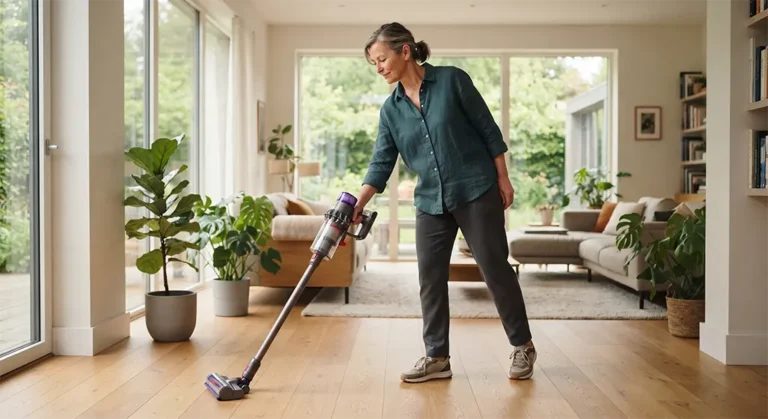
Vacuuming, mopping, sweeping, and cleaning floors can trigger low back pain because they combine bending, rotation, reaching, pushing, pulling, and repeated weight shifts. If your back catches, locks, or flares after housework, the issue may involve lumbar instability or poor hip-spine load sharing. Digital Motion X-Ray (DMX) evaluates lumbar motion in real time and can help identify translation, angulation, hinge behavior, asymmetry, or instability patterns that static imaging may miss.
- Cleaning floors is a repetitive motion task, not just light housework.
- Pain with mopping or vacuuming may reveal lumbar hinge behavior or instability.
- DMX can help guide stabilization-focused rehab and safer daily movement strategies.
Last updated: April 14, 2026
Reviewed by: DMX Miami clinical team
Many patients do not hurt their back lifting something heavy. They flare while doing normal housework.
At DMX Miami, we see patients from Miami, Fort Lauderdale, Miami-Dade County, Broward County, and the Florida Keys, and from the USA, Colombia, Chile, Argentina, Mexico, and the Caribbean, who report low back pain after cleaning floors.
Patients often say:
- “Vacuuming makes my back lock up.”
- “Mopping triggers one-sided low back pain.”
- “Sweeping feels fine at first, then I flare later.”
- “My back catches when I twist.”
- “I can walk, but cleaning floors hurts.”
- “My MRI does not explain why simple chores set me off.”
This pattern matters because cleaning is repetitive. It exposes whether the lumbar spine can control motion over time.
Why vacuuming and mopping stress the low back
Vacuuming and mopping combine several movements:
- trunk flexion
- rotation
- reaching
- pushing and pulling
- side-to-side weight shifts
- bending around furniture
- repeated small steps
- fatigue over time
The spine must stay stable while the arms and legs move. If the hips, pelvis, and lumbar spine do not share motion well, the low back may take too much stress.
The repetitive-twist problem
A single twist may not cause pain. Repeated twisting for 10–30 minutes can irritate a vulnerable segment.
This is especially common when patients:
- reach too far with the mop or vacuum
- twist from the low back instead of moving the feet
- clean under furniture
- bend and rotate at the same time
- rush through the task
- clean during an active flare
The repeated pattern becomes the trigger.
The hinge segment problem
A hinge segment is a spinal level that moves too much while nearby areas move too little. During cleaning, a hinge segment may repeatedly absorb motion that should be shared by the hips, thoracic spine, and pelvis.
Signs may include:
- sharp catch during twisting
- pain on one side
- pain after repetitive chores
- stiffness when standing upright afterward
- recurring flare in the same spot
- relief with rest but recurrence with the same task
If the same chore repeatedly creates the same pain, motion control should be evaluated.
Why static imaging may not explain cleaning-related pain

MRI and standard X-rays are valuable, but vacuuming and mopping pain happens during repeated motion. Static imaging does not show what happens during bending, reaching, rotating, and fatigue.
Static imaging may not show:
- abnormal lumbar translation
- abnormal angulation
- hinge behavior
- asymmetry during movement
- instability during flexion-extension
- poor sequencing when returning upright
This is why a patient can have mild imaging but severe functional limitation with household tasks.
How Digital Motion X-Ray helps
Digital Motion X-Ray is fluoroscopic video imaging performed during guided motion. In lumbar cases, DMX may evaluate:
- Translation: sliding between vertebrae
- Angulation: tilting between vertebrae
- Hinge behavior: one level moving excessively
- Sequencing: smooth vs irregular movement
- Asymmetry: differences between movement directions
DMX does not replace MRI, CT, orthopedic evaluation, or neurological evaluation. It complements them when symptoms are motion-triggered.
How DMX findings can change care
If abnormal motion is present, care may focus on:
- lumbar stabilization
- hip hinge training
- footwork during cleaning
- rotational control
- endurance progression
- task-specific movement retraining
- avoiding repeated bending-twisting combinations during flares
The goal is not to avoid cleaning forever. The goal is to rebuild tolerance safely.
Practical steps while awaiting evaluation
- Keep the mop or vacuum close to the body
- Move your feet instead of twisting the low back
- Break cleaning into shorter sessions
- Avoid bending and twisting together
- Switch hands or stance when appropriate
- Use longer handles to reduce flexion
- Stop before symptoms peak
- Track which motion causes pain: pushing, pulling, twisting, or bending
Safety note
Seek medical evaluation if back pain includes progressive weakness, numbness, bowel/bladder changes, fever, unexplained weight loss, severe trauma, or inability to walk.
FAQs
Why does vacuuming hurt my low back?
Vacuuming combines bending, pushing, pulling, twisting, and repeated weight shifts, which can stress motion-sensitive lumbar segments.
Can light housework reveal instability?
Yes. Repetitive low-load motion can reveal lumbar instability or poor load sharing.
What does DMX show?
DMX evaluates real-time lumbar translation, angulation, hinge behavior, asymmetry, and motion sequencing.
Does DMX replace MRI?
No. DMX complements MRI/CT/X-ray when pain is motion- or task-triggered.
References
- AAOS OrthoInfo: Low back pain and mechanical movement education
- PubMed-indexed literature on lumbar instability and segmental biomechanics
Footer: DMX Miami serves patients in Miami, Fort Lauderdale, Miami-Dade, Broward, the Florida Keys, Florida, the USA, and visitors from Colombia, Chile, Argentina, Mexico, and the Caribbean.
Learn more: Treatment
Schedule your appointment today:Appointments
Call 305-275-7475 orbook your appointment online

Dr. Rodolfo Alfonso, D.C.
Dr. Mark N. Berry, D.C.
Sunset Chiropractic and Wellness
8585 Sunset Dr. STE 102
Miami, Florida 33143