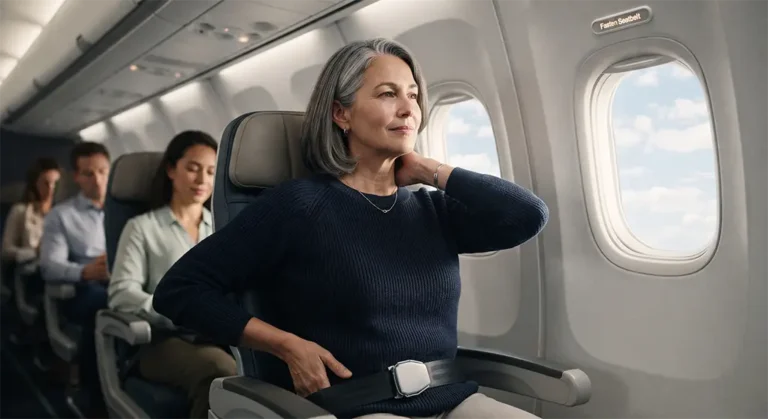
Turbulence, hard landings, long flights, and airport travel can trigger neck or back pain because they combine vibration, sudden jolts, prolonged sitting, luggage handling, and fatigue. If symptoms worsen after flying especially in patients with prior whiplash, falls, or spinal instability Digital Motion X-Ray (DMX) may help evaluate motion-based patterns such as translation, angulation, asymmetry, hinge behavior, or instability.
- Air travel can stress the spine through sitting, jolts, vibration, luggage, and fatigue.
- Pain after turbulence may reveal motion sensitivity, especially after prior injury.
- DMX helps evaluate real-time spinal motion when static imaging does not fully explain symptoms.
Last updated: April 14, 2026
Reviewed by: DMX Miami clinical team
Air travel is a major part of life in South Florida. Patients fly through Miami International Airport, Fort Lauderdale, and regional airports for work, vacation, family visits, and medical care. Visitors from Colombia, Chile, Argentina, Mexico, the Caribbean, the USA, and beyond often arrive in Miami after long flights.
For many people, flying is just tiring. But for patients with neck or back instability, air travel can trigger a significant flare.
Patients often say:
- “My neck hurt after turbulence.”
- “A hard landing flared my low back.”
- “I felt fine before flying, then my symptoms returned.”
- “The airport walk and luggage made everything worse.”
- “My back locked up after sitting on the plane.”
- “My headaches came back after the flight.”
The important point is that air travel stacks multiple spinal stressors into one day.
Why air travel can trigger spinal symptoms
A flight day includes:
- long sitting
- limited legroom
- awkward neck posture
- vibration
- turbulence
- sudden jolts
- lifting luggage
- pulling rolling bags
- airport walking
- dehydration
- poor sleep
- stress
Any one of these may be tolerable. Together, they can exceed the spine’s current capacity.
Why turbulence matters
Turbulence creates unexpected movement. The body reflexively braces. If the cervical or lumbar spine is already motion-sensitive, sudden bracing and jolting can irritate vulnerable segments.
This is especially true for patients with:
- prior whiplash
- old falls
- sports injuries
- known ligament injury
- chronic instability symptoms
- symptoms that flare with vibration or impact
Turbulence does not need to be extreme to trigger symptoms in a sensitive system.
Long sitting and the lumbar spine

Plane seats often place the hips and low back in a flexed posture. The lumbar spine may lose support, and the pelvis may tilt backward. After hours of sitting, getting up can trigger a sharp catch or spasm.
Patients may notice:
- pain standing after the flight
- first-step stiffness
- low back locking
- buttock pain
- symptoms that improve after walking
- worsening after lifting luggage
This transition pattern can suggest lumbar motion-control problems.
Neck posture during flights
Passengers often look down at phones, sleep with the head tilted, or hold awkward positions for long periods. This can trigger:
- neck pain
- base-of-skull headaches
- dizziness
- shoulder-blade burning
- heavy-head fatigue
- arm tingling
For patients with cervical instability, the problem may not appear until after landing or the next morning.
Why static imaging may not explain flight-related flares
MRI, CT, and standard X-rays are valuable. But flight-related symptoms occur during time, vibration, posture load, sudden jolts, and transitions.
Static imaging may not show:
- cervical or lumbar translation
- abnormal angulation
- hinge behavior
- asymmetry
- instability during motion
- sequencing problems
- vulnerability to vibration and fatigue
How Digital Motion X-Ray helps
Digital Motion X-Ray is fluoroscopic video imaging performed during guided motion. Depending on the region studied, DMX can evaluate:
- Translation: sliding between vertebrae
- Angulation: tilting between vertebrae
- Asymmetry: left vs right motion differences
- Hinge behavior: one segment moving too much
- Sequencing: smooth vs irregular motion
DMX does not recreate turbulence. It helps evaluate whether the spine has motion patterns that may explain why turbulence, sitting, and travel loads trigger symptoms.
How DMX findings can change care
A motion-based plan may include:
- cervical or lumbar stabilization
- posture endurance work
- travel-day rules
- safer luggage handling
- seat support strategies
- airport walking pacing
- avoiding heavy lifting immediately after long sitting
- coordination with providers when dizziness, headaches, or neurological symptoms are present
The goal is to help patients travel with fewer setbacks.
Practical steps while awaiting evaluation
- Use lumbar support during flights
- Avoid prolonged phone flexion
- Change neck position frequently
- Stand and walk when safe
- Avoid lifting heavy luggage immediately after long sitting
- Keep bags lighter and closer to the body
- Track whether symptoms begin during flight, after landing, or next morning
Safety note
Seek medical evaluation for severe headache, neurological symptoms, progressive weakness, fainting, chest pain, shortness of breath, severe numbness, or severe trauma during travel.
FAQs
Can turbulence cause neck or back pain?
Turbulence can trigger symptoms in people with motion-sensitive cervical or lumbar conditions, especially after prior injury.
Why does flying make my back hurt?
Flying combines long sitting, poor support, vibration, transitions, and luggage handling.
What does DMX show?
DMX evaluates real-time translation, angulation, asymmetry, hinge behavior, and motion sequencing.
Does DMX replace MRI?
No. DMX complements MRI/CT/X-ray when symptoms are motion-, posture-, or vibration-triggered.
References
- Cleveland Clinic: Neck pain and whiplash education
- AAOS OrthoInfo: Low back pain education
- PubMed-indexed literature on dynamic spinal biomechanics and instability
Footer: DMX Miami serves patients in Miami, Fort Lauderdale, Miami-Dade, Broward, the Florida Keys, Florida, the USA, and visitors from Colombia, Chile, Argentina, Mexico, and the Caribbean.
Learn more: Treatment
Schedule your appointment today:Appointments
Call 305-275-7475 orbook your appointment online

Dr. Rodolfo Alfonso, D.C.
Dr. Mark N. Berry, D.C.
Sunset Chiropractic and Wellness
8585 Sunset Dr. STE 102
Miami, Florida 33143