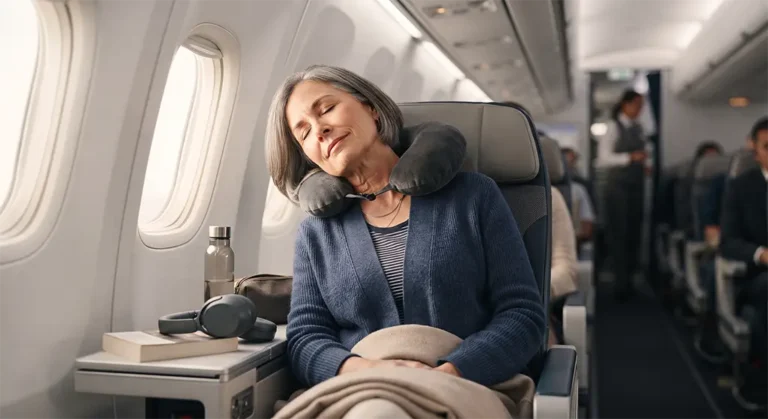
Sleeping on a plane, in a reclined car seat, or in a waiting-room chair can trigger neck pain, headaches, dizziness, shoulder-blade burning, or arm symptoms because the head often falls into flexion, extension, side-bending, or rotation without proper support. If symptoms appear after awkward seated sleep, Digital Motion X-Ray (DMX) may help evaluate cervical motion patterns such as translation, angulation, asymmetry, hinge behavior, and instability.
- Seated sleep often places the neck in unsupported end-range positions.
- Symptoms after plane sleep or reclined-seat sleep may reveal cervical motion sensitivity.
- DMX can help guide stabilization-focused care and safer travel-position strategies.
Last updated: April 14, 2026
Reviewed by: DMX Miami clinical team
Sleeping in a bed is one thing. Sleeping upright on a plane, in a car, in a recliner, or in a waiting-room chair is very different. The head may fall forward, to the side, or backward for an extended period. For patients with cervical instability or whiplash history, that can trigger a major flare.
At DMX Miami, we see this in patients traveling through Miami, Fort Lauderdale, Miami-Dade County, Broward County, and the Florida Keys, and from visitors from the USA, Colombia, Chile, Argentina, Mexico, and the Caribbean.
Patients often say:
- “I slept on the plane and woke up with neck pain.”
- “My head fell to the side, and my headache started.”
- “Reclined seats make my neck worse.”
- “I get shoulder-blade burning after travel sleep.”
- “My arm tingles after sleeping awkwardly.”
- “I feel like my neck cannot tolerate unsupported positions.”
This pattern is common because seated sleep removes active neck control.
Why seated sleep stresses the neck
When you are awake, the neck muscles constantly adjust to support the head. When you fall asleep, muscle control decreases. The head may drift into a position the cervical spine cannot tolerate.
Common positions include:
- chin-to-chest flexion
- head tilted to one side
- head rotated on a headrest
- neck extended backward
- shoulder elevated under the ear
- unsupported forward head posture
Any of these positions can irritate motion-sensitive cervical segments.
Why planes make it worse
Plane seats add several stressors:
- limited space
- narrow headrests
- vibration
- turbulence
- fatigue
- dehydration
- awkward pillows
- long duration
- limited ability to move
A patient with a stable neck may wake up stiff. A patient with cervical instability may wake with headaches, dizziness, or symptoms that last days.
Why symptoms may appear after travel
Patients may not feel pain while sleeping. Symptoms may appear when they wake, move, carry luggage, or drive after landing.
A typical pattern:
- Patient sleeps with head unsupported
- Neck rests in awkward position
- Motion-sensitive segment becomes irritated
- Muscles guard
- Patient wakes with stiffness or headache
- Driving, luggage, or screen use worsens symptoms
This delayed flare is still meaningful.
Why static imaging may not explain it
MRI and standard X-rays may not show why an unsupported sleep position causes symptoms. The issue is not only what the neck looks like at rest. The issue is how the cervical spine tolerates posture, motion, and end-range positioning.
Static imaging may not show:
- abnormal translation
- abnormal angulation
- upper cervical asymmetry
- hinge behavior
- instability during movement
- poor sequencing after prolonged posture
How Digital Motion X-Ray helps
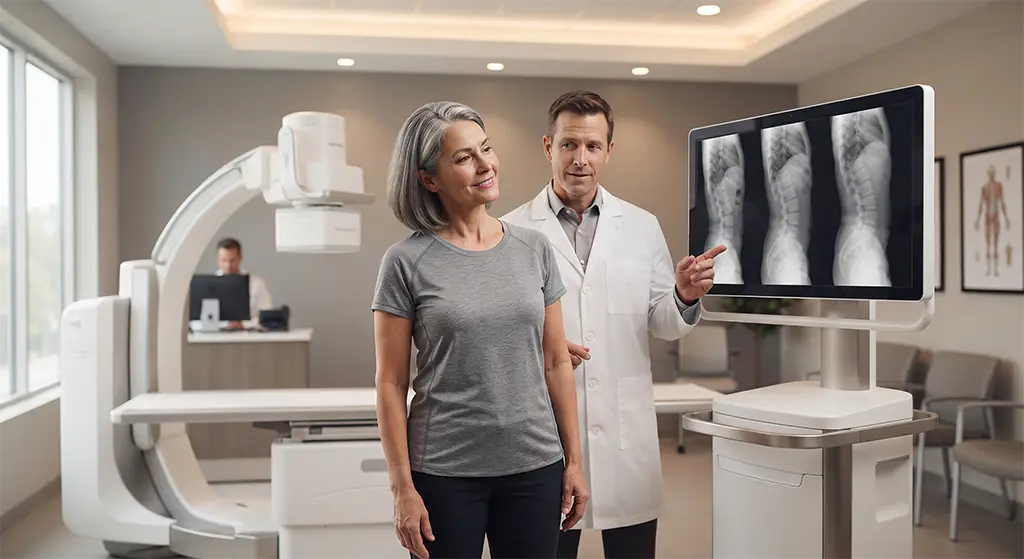
Digital Motion X-Ray is fluoroscopic video X-ray performed during guided cervical motion. It can help evaluate real-time cervical mechanics.
DMX may assess:
- Translation: abnormal sliding between vertebrae
- Angulation: abnormal tilting between vertebrae
- Asymmetry: left-right differences
- Hinge behavior: one segment moving too much
- Sequencing: smooth vs irregular motion
DMX does not replace MRI, CT, neurological evaluation, or sleep-related medical evaluation. It complements them when symptoms are posture- or motion-triggered.
How DMX findings can change care
If abnormal cervical motion is identified, care may include:
- cervical stabilization
- posture endurance training
- safer travel-position strategies
- reducing end-range sleep positions
- better pillow selection
- gradual tolerance training
- safer manual therapy choices
The goal is to help patients travel and rest without repeated setbacks.
Practical steps for travel
- Use neck support that prevents side collapse
- Avoid sleeping with the chin sharply down
- Avoid letting the head fall backward unsupported
- Change position before symptoms build
- Support arms to reduce shoulder pull
- Stand and walk when safe
- Avoid heavy luggage immediately after waking from awkward seated sleep
- Track which position triggers symptoms
Safety note
Seek medical evaluation if neck pain after travel includes severe headache, dizziness, fainting, neurological symptoms, progressive weakness, vision changes, or symptoms after head trauma.
FAQs
Why does sleeping on a plane hurt my neck?
Seated sleep often allows the head to fall into unsupported flexion, extension, rotation, or side-bending.
Can awkward sleep trigger whiplash symptoms?
Yes. A previously injured or unstable neck may flare after prolonged unsupported positioning.
What does DMX show?
DMX evaluates real-time cervical translation, angulation, asymmetry, hinge behavior, and motion sequencing.
Does DMX replace MRI?
No. DMX complements MRI/CT/X-ray when symptoms are posture- or motion-triggered.
References
- Cleveland Clinic: Whiplash, neck pain, and cervicogenic headache education
- PubMed-indexed literature on cervical videofluoroscopy, cervical instability, and dynamic motion assessment
Footer: DMX Miami serves patients in Miami, Fort Lauderdale, Miami-Dade, Broward, the Florida Keys, Florida, the USA, and visitors from Colombia, Chile, Argentina, Mexico, and the Caribbean.
Learn more: Treatment
Schedule your appointment today:Appointments
Call 305-275-7475 orbook your appointment online

Dr. Rodolfo Alfonso, D.C.
Dr. Mark N. Berry, D.C.
Sunset Chiropractic and Wellness
8585 Sunset Dr. STE 102
Miami, Florida 33143