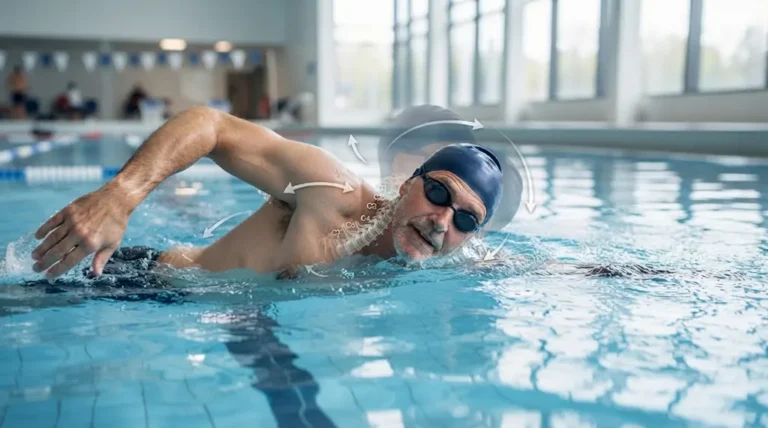
Swimming is generally a low-impact activity, but certain strokes repeatedly move the cervical spine through rotation and extension. Freestyle breathing requires quick head rotation, while breaststroke may keep the neck extended and sighting during open-water swimming can require repeated lifting of the head. If swimming consistently produces neck pain, headache, dizziness, shoulder-blade burning, or arm symptoms, the problem may involve cervical motion sensitivity rather than simply “tight muscles.” Digital Motion X-Ray can provide information about vertebral movement during controlled cervical motion.
- Different swimming strokes place different demands on the cervical spine.
- Freestyle breathing repeatedly rotates the neck.
- Breaststroke and open-water sighting can increase cervical extension.
- Previous whiplash may reduce tolerance for repetitive head movement.
- DMX may complement other evaluation when symptoms are reproducibly motion-triggered.
Last updated: September 22, 2026
Reviewed by: DMX Miami clinical team
Swimming is often recommended because it reduces impact on the joints.
But “low impact” does not mean “no cervical motion.”
Patients sometimes tell us:
- “My neck hurts every time I turn to breathe.”
- “Freestyle makes one side of my neck flare.”
- “Breaststroke gives me a headache.”
- “Looking forward in the water hurts my neck.”
- “Swimming was fine before my accident.”
- “My shoulder blade burns afterward.”
For patients in Miami, Miami Beach, Fort Lauderdale, Miami-Dade County, Broward County, and the Florida Keys, swimming is not just exercise.
It is part of the lifestyle.
Understanding why a particular stroke triggers symptoms can help determine what needs to be evaluated.
Freestyle Requires Repetitive Rotation
During freestyle, the swimmer repeatedly rotates the head to breathe.
A swimmer who breathes to the same side may perform that cervical rotation hundreds of times in one workout.
If the cervical spine is motion-sensitive, repetition matters.
The first ten rotations may feel fine.
After several hundred, symptoms may appear.
One-Sided Breathing Can Expose Asymmetry
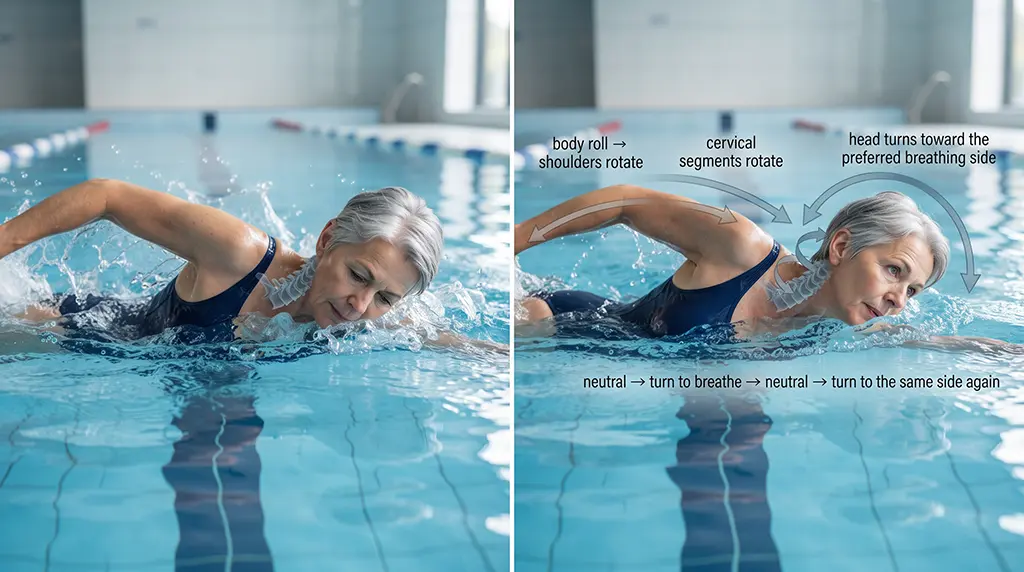
Many swimmers naturally breathe almost exclusively to one side.
That creates repeated movement in the same direction.
A patient may notice:
- left rotation feels normal
- right rotation causes pain
or the opposite.
This type of asymmetry can provide useful clinical information.
Possible contributors include:
- joint restriction
- muscular guarding
- shoulder dysfunction
- thoracic limitation
- previous injury
- altered cervical movement
No single symptom proves instability, but the pattern deserves evaluation.
Breaststroke Creates a Different Challenge
Breaststroke may involve prolonged or repeated cervical extension if the swimmer keeps the head above the water.
That can stress:
- suboccipital muscles
- cervical facet joints
- upper cervical region
- lower cervical segments
- cervicothoracic junction
Patients who are sensitive to looking upward may find breaststroke particularly provocative.
Open-Water Swimming Adds Sighting
Ocean and open-water swimmers frequently lift the head to see:
- buoys
- shoreline
- boats
- other swimmers
This “sighting” movement often combines extension and rotation.
In rough water, the movement may also become faster and less controlled.
Why Prior Whiplash Can Matter
Whiplash can leave some patients less tolerant of repeated:
- rotation
- extension
- sudden movement
- endurance demands
A person who previously swam without difficulty may find that the same stroke becomes symptomatic after an accident.
That does not automatically establish instability.
But it does tell us that the neck’s functional tolerance changed.
Why Static Imaging May Not Explain Swimming Pain
An MRI or CT can provide important structural information.
But swimming symptoms happen during:
- repeated rotation
- extension
- muscular endurance
- breathing coordination
A static scan cannot reproduce an entire swimming session.
The clinical question may therefore include:
How does the cervical spine behave during movement?
How Digital Motion X-Ray Helps
Digital Motion X-Ray uses fluoroscopic imaging while the patient performs guided cervical movement.
Assessment may include:
- translation
- angulation
- asymmetry
- hinge behavior
- motion sequencing
DMX is only one component of evaluation.
Shoulder function, neurological examination, vestibular symptoms, stroke mechanics, and other factors may also need to be considered.
Practical Modifications While Being Evaluated
Depending on symptoms:
- reduce repeated end-range rotation
- alternate breathing sides if comfortably possible
- avoid prolonged head-up breaststroke
- use shorter swimming sessions
- stop if dizziness develops
- avoid repeatedly testing painful movement
- consider technique coaching
- gradually rebuild tolerance rather than jumping directly back to previous volume
The Goal Is Not to Avoid Swimming Forever
The goal is to understand the trigger.
For many patients, swimming is valuable for:
- cardiovascular fitness
- endurance
- recreation
- stress management
- general conditioning
An effective plan should ideally help the patient return to meaningful activity.
How DMX Findings May Affect Rehabilitation
If the overall evaluation identifies a motion-control problem, rehabilitation may emphasize:
- cervical stabilization
- rotational control
- upper cervical endurance
- scapular stabilization
- thoracic mobility
- graded return to swimming
- breathing-side progression
The treatment plan should address the actual activity that matters to the patient.
Safety Note
Stop swimming and seek medical evaluation for severe dizziness, fainting, new significant weakness, severe headache, major visual symptoms, loss of coordination, or neurological symptoms. Those symptoms should not be assumed to originate from the cervical spine.
FAQs
Can swimming cause neck pain?
Yes. Swimming can involve repeated cervical rotation and extension depending on the stroke and breathing technique.
Why does freestyle hurt only when I breathe to one side?
One-sided symptoms may reflect differences in cervical, shoulder, or upper-back movement and deserve evaluation if persistent.
Can previous whiplash make swimming harder?
Yes. Some patients develop reduced tolerance for repetitive cervical movement after whiplash.
Can DMX determine whether my swimming stroke is wrong?
No. DMX evaluates cervical motion. Stroke mechanics may require evaluation by a swimming or rehabilitation professional.
References
- Cleveland Clinic: Whiplash
- PubMed-indexed literature on cervical motion and dynamic imaging
- Sports medicine literature on swimming-related cervical loading
Footer: DMX Miami serves patients in Miami, Fort Lauderdale, Miami-Dade, Broward, the Florida Keys, Florida, the USA, and visitors from Colombia, Chile, Argentina, Mexico, and the Caribbean.
Learn more: Treatment
Schedule your appointment today:Appointments
Call 305-275-7475 orbook your appointment online

Dr. Rodolfo Alfonso, D.C.
Dr. Mark N. Berry, D.C.
Sunset Chiropractic and Wellness
8585 Sunset Dr. STE 102
Miami, Florida 33143